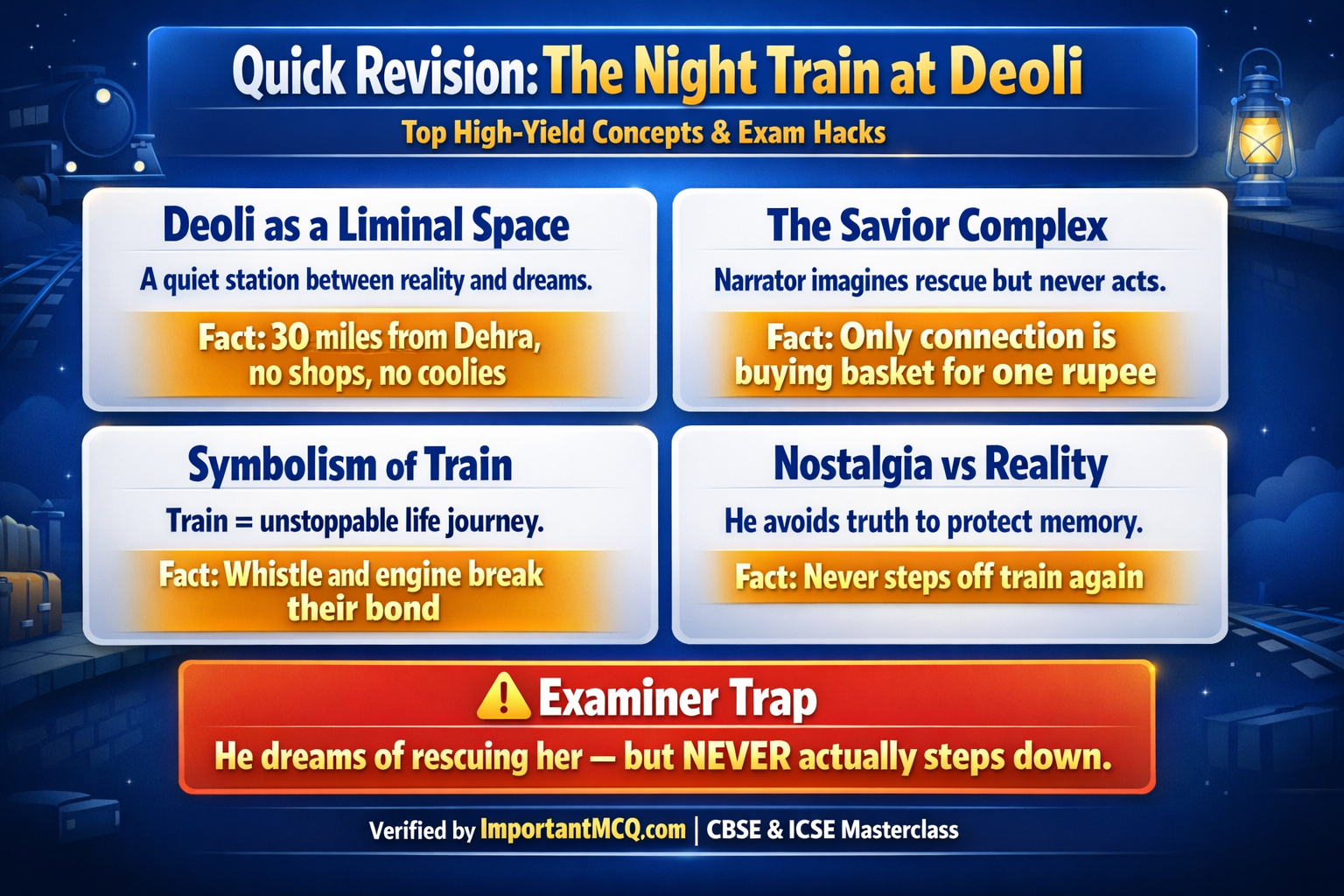
Looking for the most important the night train at deoli mcq for your upcoming exams? We have analyzed past papers for CBSE Class 12 English, ICSE, UP Board, and CUET (UG) to bring you the 50 most expected questions. Take the live test, review the blueprint, and master the core concepts.
- 🚀 Updated for 2026: Aligned with the latest CBSE Class 12 English, ICSE, UP Board, and CUET (UG) syllabus.
- 🧠 Output & Concept Based: Covers basics to advanced scenarios.
- 📊 Live Gamification: Track your score and time dynamically.
- 📥 Buy PDF: Available instantly via our Telegram channel.
Test Blueprint & Topic Weightage
| Section / Topic | Question Range | Difficulty Level |
|---|---|---|
| Setting & Atmosphere (Deoli Station) | Q1 – Q11 | Easy to Medium |
| The Encounters & The Girl | Q12 – Q20 | Medium |
| Psychology, Symbolism & Themes | Q21 – Q50 | Hard |
⚠️ Examiner Trap Alert: Students often confuse the narrator’s grand romantic thoughts with his actual physical actions. Remember that despite his passionate internal vows to “rescue” the girl, he never actually steps out of the station or takes any real-world action, entirely paralyzed by his fear of reality.
Test Blueprint & Topic Weightage
⏱️ Estimated Time: 37 Minutes | 🎯 Target Score: 40+ | 📊 Difficulty: Moderate to Hard
📚 Interactive Question Bank
Select a question to view the expert explanation and answer.
✅ | Setting & Atmosphere (Deoli Station)
Q1Consider the following statements regarding the narrator's journey schedule and background:Q2Consider the following statements regarding the geographical location and infrastructure of Deoli station:Q3Consider the following statements regarding the night train's routine halt at Deoli:Q4Consider the following statements regarding the visual and atmospheric details of Deoli at dawn:Q5Consider the following statements regarding the narrator's emotional perception of Deoli station prior to meeting the girl:Q6Consider the following statements regarding the physical appearance and attire of the girl at Deoli station:Q7Consider the following statements regarding the initial interaction between the narrator and the girl at the train window:Q8Consider the following statements regarding the transaction of the basket:Q9Consider the following statements regarding the train's departure from Deoli station:Q10Consider the following statements regarding the narrator's state of mind immediately after leaving Deoli:Q11Consider the following statements regarding the narrator's departure from Dehra at the end of his summer vacation:
✅ | The Encounters & The Girl
Q12Consider the following statements regarding the second meeting between the narrator and the girl at Deoli station:Q13Consider the following statements regarding the physical interaction and dialogue during the second encounter:Q14Consider the following statements regarding the interruption and end of their second encounter:Q15Consider the following statements regarding the narrator's immediate emotional resolve after the train left Deoli for the second time:Q16Consider the following statements regarding the narrator's third journey to Deoli at the end of his college term:Q17Consider the following statements regarding the narrator's first inquiry about the missing girl:Q18Consider the following statements regarding the narrator's shortened stay at his grandmother's house:Q19Consider the following statements regarding the narrator's interaction with the tea stall owner:Q20Consider the following statements regarding the narrator's ultimate resolution as the train left Deoli without answers:
✅ | Psychology, Symbolism & Themes
Q21Consider the following statements regarding the narrator's perception of the town of Deoli:Q22Consider the following statements regarding the narrator's specific fears about the girl's fate:Q23Consider the following statements regarding the narrator's behavior during his final college years:Q24Consider the following statements regarding the narrator's self-awareness and rationalization of his actions:Q25Consider the following statements regarding the thematic conclusion of the story:Q26Consider the following statements regarding the narrator's interaction with the new stationmaster at Deoli:Q27Consider the following statements regarding the physical description and attitude of the tea-stall owner:Q28Consider the following statements regarding the visual imagery beyond the Deoli station railings:Q29Consider the following statements regarding the girl's social standing and anonymity among the locals:Q30Consider the following statements regarding the narrator's decision against making a formal inquiry:Q31Consider the following statements regarding the theme of nostalgia in "The Night Train at Deoli":Q32Consider the following statements regarding the symbolism of the train in the narrative:Q33Consider the following statements regarding the socio-economic contrast between the narrator and the girl:Q34Consider the following statements regarding the story's portrayal of adolescent infatuation:Q35Consider the following statements regarding the significance of Deoli as a "liminal space":Q36Consider the following statements regarding the structural irony of the narrator's romantic declarations:Q37Consider the following statements regarding the geographic and symbolic contrast between Delhi and Deoli:Q38Consider the following statements regarding the narrator's psychological defense mechanisms:Q39Consider the following statements regarding the narrative function of the grandmother in Dehra:Q40Consider the following statements regarding the visual motif of light and darkness in the story:Q41Consider the following statements regarding the distortion of time in the narrator's experience:Q42Consider the following statements regarding the physical symbolism of the cane basket:Q43Consider the following statements regarding the symbolic contrast between Deoli and Dehra:Q44Consider the following statements regarding the narrator's psychological "savior complex":Q45Consider the following statements regarding the long-term psychological outcome of the narrator's choices:Q46Consider the following statements regarding the literary meaning of specific phrases used to describe the girl's eyes:Q47Consider the following statements regarding the narrator's use of figurative language to describe the Deoli platform:Q48Consider the following statements regarding the narrative perspective of the story:Q49Consider the following statements regarding the meaning of the word "Intrepid" in the context of the story's themes:Q50Consider the following statements regarding the structural function of the story's "Open Ending":
Page 1 of 1 (50 Total Questions)
High-Yield Core Concepts
Deoli as a Liminal Space
The isolated, desolate station acts as a transitional boundary between the narrator’s structured life in Delhi/Dehra and his romanticized fantasies, a common trope in classic Ruskin Bond short stories.
The Illusion of the Savior Complex
The character sketch of the narrator reveals a privileged college student who projects a heroic “rescue” fantasy onto an impoverished vendor, preferring the aesthetic of tragedy over the messy reality of helping her.
The Symbolism of the Train
The mechanical rhythm of the train represents relentless forward momentum and the unstoppable schedule of adulthood, literally forcing the narrator away from his youthful infatuation.
Fear of Reality vs. Comfort of Nostalgia
The ultimate tragedy of the story is the narrator’s deliberate choice to remain ignorant of the girl’s true fate (death or marriage) to protect his perfect, unchanging memory of their fleeting connection.
Semantic Comparison
| Feature / Metric | The Night Train at Deoli | The Eyes Have It |
|---|---|---|
| Core Definition | A story of an unresolved, fleeting romance at an isolated, forgotten railway station. | A story of a brief, hidden connection between two blind passengers sharing a train compartment. |
| Primary Use Case | Explores themes of adolescent infatuation, nostalgia, and the fear of confronting harsh realities. | Explores themes of perception, situational irony, and the desire to conceal one’s vulnerabilities. |
| Exam Importance | Highly tested on symbolism (liminal spaces, the train) and the socio-economic divide. | Highly tested on dramatic irony, dialogue analysis, and sensory descriptive imagery. |
Frequently Asked Questions
Why is the night train at deoli mcq critical for CBSE Class 12 English, ICSE, and CUET?
It is a consistently high-scoring area. Examiners frequently repeat core concepts from this section, particularly regarding the psychological motivations of the narrator and the symbolism of the setting.
Does this mock test cover the full syllabus?
Yes, these questions target the most highly-weighted concepts found in previous years’ CBSE Class 12 English questions and board papers, covering everything from factual details of the platform to deep thematic analysis.
How does this help with subjective answers?
By mastering these MCQs, you inadvertently memorize The Night Train at Deoli summary and key quotes, which acts as a foundational framework for writing long-form literary analysis essays.