- ✓🚀 Updated for 2026: Aligned with the latest CBSE Class 12 English, ICSE, UP Board, and CUET (UG) syllabus.
- ✓🧠 Output & Concept Based: Covers basics to advanced scenarios.
- ✓📊 Live Gamification: Track your score and time dynamically.
- ✓📥 Buy PDF: Available instantly via our Telegram channel.
Test Blueprint & Topic Weightage
| Section / Topic | Question Range | Difficulty Level |
|---|---|---|
| Setting & Atmosphere (Deoli Station) | Q1 – Q11 | Easy to Medium |
| The Encounters & The Girl | Q12 – Q20 | Medium |
| Psychology, Symbolism & Themes | Q21 – Q50 | Hard |
Practice the night train at deoli mcq (Live Mock Test)
⏱️ Estimated Time: 37 Minutes | 🎯 Target Score: 40+ | 📊 Difficulty: Moderate to Hard
The Night Train at Deoli MCQ – 50 Most Expected Questions
Supercharge Your Preparation
Join our Telegram to practice more MCQs and guarantee your selection.
📱 Join Telegram💬 Community Doubts
High-Yield Core Concepts
Semantic Comparison: The Night Train at Deoli vs The Eyes Have It
| Feature / Metric | The Night Train at Deoli | The Eyes Have It |
|---|---|---|
| Core Definition | A story of an unresolved, fleeting romance at an isolated, forgotten railway station. | A story of a brief, hidden connection between two blind passengers sharing a train compartment. |
| Primary Use Case | Explores themes of adolescent infatuation, nostalgia, and the fear of confronting harsh realities. | Explores themes of perception, situational irony, and the desire to conceal one’s vulnerabilities. |
| Exam Importance | Highly tested on symbolism (liminal spaces, the train) and the socio-economic divide. | Highly tested on dramatic irony, dialogue analysis, and sensory descriptive imagery. |
Why is the night train at deoli mcq critical for CBSE Class 12 English, ICSE, and CUET?
Does this mock test cover the full syllabus?
How does this help with subjective answers?
Multiple Choice Questions
Question 1: Consider the following statements regarding the narrator’s journey schedule and background: 1. The narrator would leave the plains early in May and return late in July to visit his grandmother’s place in Dehra. 2. At the time of the events described in the story, the narrator was an eighteen-year-old college student. 3. Deoli station marked the end of the heavy jungles of the Indian Terai. Which of the above statements is/are correct?
- Only 1 and 2 (Correct Answer)
- Only 2 and 3
- Only 1 and 3
- 1, 2, and 3
Explanation
Direct Answer: Statements 1 and 2 are correct, while Statement 3 is incorrect.Concept Definition: The introduction to Ruskin Bond’s The Night Train at Deoli establishes the narrator’s routine and the geographical context of his journey.Structural Breakdown: The narrator, an 18-year-old college student, traveled to Dehra every summer, leaving in early May and returning in late July.Deoli marked the beginning, not the end, of the heavy jungles of the Indian Terai.Historical/Related Context: The Terai region is a lowland belt characterized by tall grasslands and dense forests at the foothills of the Himalayas, which sets a mysterious and isolated tone for Deoli station.Causal Reasoning: Statement 3 is incorrect because Deoli served as the threshold or starting point into this dense forest region, which emphasizes the isolation of the setting before the train plunges into the wilderness.🔗 Continue Practicing:➔ Active and Passive Voice MCQ – 100 Most Expected Questions
Question 2: Consider the following statements regarding the geographical location and infrastructure of Deoli station: 1. Deoli was a small railway station located exactly thirty miles from Dehra. 2. The station platform was well-equipped with a tea stall, a fruit vendor, a bookshop, and a waiting room. 3. The train would reach the station at about five in the morning, when it was dimly lit with electric bulbs and oil-lamps. Which of the above statements is/are correct?
- Only 1 and 2
- Only 1 and 3 (Correct Answer)
- Only 2 and 3
- 1, 2, and 3
Explanation
Direct Answer: Statements 1 and 3 are correct, while Statement 2 is incorrect.Concept Definition: The physical setting of Deoli station is a critical examinable fact in board patterns, highlighting its desolate and minimal infrastructure.Structural Breakdown: The text explicitly states that Deoli is thirty miles from Dehra and the train arrives at 5 AM. The station had a lone platform, a stationmaster’s office, a waiting room, a tea stall, a fruit vendor, and stray dogs.It did not have a bookshop.Historical/Related Context: Board exam MCQs frequently test the exact list of amenities on the Deoli platform to ensure students can distinguish it from bustling city junctions.Causal Reasoning: Statement 2 is incorrect because the deliberate absence of facilities like a bookshop reinforces the station’s forgotten, isolated nature where nobody ever gets on or off the train.🔗 Continue Practicing:➔ Active and Passive Voice MCQ – 100 Most Expected Questions
Question 3: Consider the following statements regarding the night train’s routine halt at Deoli: 1. The train would halt at the Deoli platform for a full ten minutes before rushing on into the forests. 2. Despite the station’s isolation, there were always a few coolies on the platform assisting the rare passengers. 3. The train’s departure from Deoli was signaled by the sounding of a bell and the guard blowing his whistle. Which of the above statements is/are correct?
- Only 1 and 2
- Only 2 and 3
- Only 1 and 3 (Correct Answer)
- 1, 2, and 3
Explanation
Direct Answer: Statements 1 and 3 are correct, while Statement 2 is incorrect.Concept Definition: The operational schedule of the train at Deoli station illustrates the paradox of the stop—a mandatory halt where no actual passenger activity occurs.Structural Breakdown: The train stops for exactly ten minutes.During this time, the narrator notes that nobody ever got in or off, and there were never any coolies on the platform.The departure sequence involves a bell sounding followed by the guard’s whistle.Historical/Related Context: The ten-minute halt serves as the crucial, narrow window of time for the narrator’s brief, intense encounters with the basket-selling girl in subsequent parts of the story.Causal Reasoning: Statement 2 is incorrect because Ruskin Bond explicitly writes that there were never any coolies on the platform, which underscores the complete lack of human traffic and commercial activity at this mysterious transit point.🔗 Continue Practicing:➔ Active and Passive Voice MCQ – 100 Most Expected Questions
Question 4: Consider the following statements regarding the visual and atmospheric details of Deoli at dawn: 1. Deoli was a junction with a double-platform structure to accommodate multiple passing trains. 2. The jungle across the railway tracks was just visible in the faint light of dawn when the train arrived. 3. Beyond the lone platform, the station’s built infrastructure consisted only of a stationmaster’s office and a waiting room. Which of the above statements is/are correct?
- Only 1 and 2
- Only 2 and 3 (Correct Answer)
- Only 1 and 3
- 1, 2, and 3
Explanation
Direct Answer: Statements 2 and 3 are correct, while Statement 1 is incorrect.Concept Definition: The visual imagery of Deoli at 5 AM relies on contrasts between the dim artificial lights of the station and the encroaching natural darkness of the Terai jungle.Structural Breakdown: The station features an only lone platform, not a double platform.The built environment is restricted to this single platform, the stationmaster’s office, and a waiting room.At 5 AM, the dense jungle across the tracks is barely discernible in the early morning light.Historical/Related Context: In literary analysis tested in board exams, this stark, minimalistic setting acts as a blank canvas, forcing the narrator’s full attention onto the only dynamic element present: the basket-selling girl.Causal Reasoning: Statement 1 is incorrect because the text explicitly describes Deoli as having an only lone platform, reinforcing its status as an insignificant, minor stop rather than a busy railway junction.🔗 Continue Practicing:➔ Active and Passive Voice MCQ – 100 Most Expected Questions
Question 5: Consider the following statements regarding the narrator’s emotional perception of Deoli station prior to meeting the girl: 1. The narrator always felt a sense of sorrow for the lonely little platform because it was a place nobody wanted to visit. 2. The narrator often got off the train to spend the entire day exploring the town behind the station walls. 3. The narrator frequently wondered about the hidden life and activities that took place in Deoli behind the station walls. Which of the above statements is/are correct?
- Only 1 and 2
- Only 2 and 3
- Only 1 and 3 (Correct Answer)
- 1, 2, and 3
Explanation
Direct Answer: Statements 1 and 3 are correct, while Statement 2 is incorrect.Concept Definition: The narrator’s internal monologue establishes his initial fascination and empathy for the forgotten station, which predates his romantic infatuation.Structural Breakdown: Before ever seeing the girl, the narrator felt sorry for the lonely platform and intensely curious about what lay behind the station walls.He resolved that one day he would get off and spend the day there just to please the town.Historical/Related Context: This curiosity sets the psychological foundation for the story.His desire to explore the unknown town mirrors his later desire to know the unknown girl, both of which remain unfulfilled mysteries by the story’s end.Causal Reasoning: Statement 2 is incorrect because the narrator only decided that he would get off the train one day; he never actually did it.His fear of ruining the mystery kept him confined to the train.🔗 Continue Practicing:➔ Active and Passive Voice MCQ – 100 Most Expected Questions
Question 6: Consider the following statements regarding the physical appearance and attire of the girl at Deoli station: 1. The girl was dressed in old clothes and had a shawl thrown across her shoulders to protect against the cold morning. 2. She possessed pale skin, shiny black hair, and dark, troubled eyes. 3. Despite her impoverished background, she was wearing expensive sandals and walked with a hurried, careless gait. Which of the above statements is/are correct?
- Only 1 and 2 (Correct Answer)
- Only 2 and 3
- Only 1 and 3
- 1, 2, and 3
Explanation
Direct Answer: Statements 1 and 2 are correct, while Statement 3 is incorrect.Concept Definition: Ruskin Bond provides a highly specific physical profile of the basket-selling girl, which serves as a recurring motif in board exam questions testing character description.Structural Breakdown: The text explicitly states she had a pale skin set off by shiny black hair, and dark, troubled eyes.She wore old clothes and a shawl.Historical/Related Context: Her poverty is juxtaposed against her natural grace.This contrast is a classic literary device used by Bond to emphasize the narrator’s immediate infatuation with her innate dignity.Causal Reasoning: Statement 3 is incorrect because the text explicitly notes that her feet were bare, not wearing expensive sandals, and that she walked gracefully and with dignity.🔗 Continue Practicing:➔ Active and Passive Voice MCQ – 100 Most Expected Questions
Question 7: Consider the following statements regarding the initial interaction between the narrator and the girl at the train window: 1. When the girl first came to the narrator’s window, she immediately asked him where his train was heading. 2. The narrator was looking at her intently, but at first, she pretended not to notice him staring. 3. Once her searching and eloquent eyes met his, they stood looking at each other for some time without saying anything. Which of the above statements is/are correct?
- Only 1 and 2
- Only 2 and 3 (Correct Answer)
- Only 1 and 3
- 1, 2, and 3
Explanation
Direct Answer: Statements 2 and 3 are correct, while Statement 1 is incorrect.Concept Definition: The initial unspoken communication establishes the deep, instantaneous connection between the two characters, relying entirely on eye contact and body language.Structural Breakdown: The sequence of events is highly specific: she stops at his window, pretends not to notice him looking intently at her, and then their eyes finally meet.Historical/Related Context: Board exams frequently test this moment to assess students’ understanding of Bond’s theme of unspoken adolescent infatuation.Causal Reasoning: Statement 1 is incorrect because the girl did not initiate conversation upon arriving at the window.The text emphasizes that neither of them said anything for what seemed a very long time before she finally asked if he wanted to buy a basket.🔗 Continue Practicing:➔ Active and Passive Voice MCQ – 100 Most Expected Questions
Question 8: Consider the following statements regarding the transaction of the basket: 1. The girl claimed that her baskets were very strong and made of the finest cane. 2. The narrator immediately bought a basket the moment she offered it, eager to support her financially. 3. When the narrator finally bought the basket on top of the pile, he gave her one rupee and hardly dared to touch her fingers. Which of the above statements is/are correct?
- Only 1 and 2
- Only 1 and 3 (Correct Answer)
- Only 2 and 3
- 1, 2, and 3
Explanation
Direct Answer: Statements 1 and 3 are correct, while Statement 2 is incorrect.Concept Definition: The transaction over the basket serves as the only physical exchange between the characters during their first encounter, acting as an excuse for prolonged interaction.Structural Breakdown: The girl advertises the baskets as being made of the finest cane.The narrator initially refuses but changes his mind after another long pause, paying exactly one rupee.Historical/Related Context: The material of the basket (cane) and the specific price (one rupee) are frequent factual trivia points.Causal Reasoning: Statement 2 is incorrect because the narrator did not buy it immediately.He initially refused her offer, and they stood looking at each other before he finally relented.🔗 Continue Practicing:➔ Active and Passive Voice MCQ – 100 Most Expected Questions
Question 9: Consider the following statements regarding the train’s departure from Deoli station: 1. As the girl was about to speak to the narrator, the stationmaster arrived and ordered her off the platform. 2. Whatever the girl attempted to say was lost in the clanging of the bell and the hissing of the engine. 3. As the train shuddered and jolted forward, she remained standing alone on the platform, looking at him and smiling. Which of the above statements is/are correct?
- Only 1 and 2
- Only 2 and 3 (Correct Answer)
- Only 1 and 3
- 1, 2, and 3
Explanation
Direct Answer: Statements 2 and 3 are correct, while Statement 1 is incorrect.Concept Definition: The departure scene uses intense auditory and visual imagery to sharply sever the quiet, intimate connection formed between the characters.Structural Breakdown: The interruption is caused mechanically by the train itself—specifically the guard blowing his whistle, the bell clanging, and the engine hissing.Historical/Related Context: The sensory details of the engine and bell represent the harsh reality of the narrator’s forward momentum.Causal Reasoning: Statement 1 is incorrect because the stationmaster does not intervene or chase her away.The interruption is purely mechanical.🔗 Continue Practicing:➔ Active and Passive Voice MCQ – 100 Most Expected Questions
Question 10: Consider the following statements regarding the narrator’s state of mind immediately after leaving Deoli: 1. The narrator watched the girl from his carriage until a signal-box came in the way and the jungle hid the station. 2. He sat up awake for the rest of the journey, unable to rid his mind of the picture of the girl’s face and her dark, smouldering eyes. 3. Upon reaching his grandmother’s house in Dehra, his obsession with the girl consumed his every waking thought for the entire vacation. Which of the above statements is/are correct?
- Only 1 and 2 (Correct Answer)
- Only 2 and 3
- Only 1 and 3
- 1, 2, and 3
Explanation
Direct Answer: Statements 1 and 2 are correct, while Statement 3 is incorrect.Concept Definition: This segment explores the psychological reality of teenage infatuation, demonstrating how intense initial feelings can be temporarily suppressed by routine life.Structural Breakdown: Immediately after departure, the narrator is fixated on her image, staying awake for the rest of the journey.However, once he arrives in Dehra, the memory fades.Historical/Related Context: Board exam literary analysis requires students to understand that the narrator’s love is romanticized and fleeting during his vacation.Causal Reasoning: Statement 3 is incorrect because the text explicitly states that when he reached Dehra, the incident became blurred and distant, as there were other things to occupy his mind.🔗 Continue Practicing:➔ Active and Passive Voice MCQ – 100 Most Expected Questions
Question 11: Consider the following statements regarding the narrator’s departure from Dehra at the end of his summer vacation: 1. The narrator deliberately chose to leave his grandmother’s house earlier than his usual departure schedule. 2. Throughout his entire stay in Dehra, his obsession with the girl never faded, causing him to avoid socializing with his family. 3. As the return train approached Deoli, the narrator experienced an unexpected thrill and nervously looked out the carriage window. Which of the above statements is/are correct?
- Only 1 and 2
- Only 2 and 3
- Only 1 and 3 (Correct Answer)
- 1, 2, and 3
Explanation
Direct Answer: Statements 1 and 3 are correct, while Statement 2 is incorrect.Concept Definition: The transition from the narrator’s forgotten summer routine back to his active infatuation illustrates the transient yet intense nature of adolescent emotion.Structural Breakdown: The text notes that the grandmother would have been pleased with his early departure.As the train nears Deoli, his buried memory resurfaces, giving him an “unexpected thrill.” Historical/Related Context: Board exams often test this specific emotional pivot.Causal Reasoning: Statement 2 is incorrect because the text explicitly states that during his two months in Dehra, he completely forgot about her as other things occupied his mind.🔗 Continue Practicing:➔ Active and Passive Voice MCQ – 100 Most Expected Questions
Question 12: Consider the following statements regarding the second meeting between the narrator and the girl at Deoli station: 1. When the train arrived, the narrator saw the girl walking down the platform and immediately sprang open the door to step off the train. 2. Unlike their first encounter, the girl did not immediately attempt to sell him a basket but instead smiled in mutual recognition. 3. The narrator formally introduced himself, and they exchanged their names and permanent addresses while standing near the tea stall. Which of the above statements is/are correct?
- Only 1 and 2 (Correct Answer)
- Only 1 and 3
- Only 2 and 3
- 1, 2, and 3
Explanation
Direct Answer: Statements 1 and 2 are correct, while Statement 3 is incorrect.Concept Definition: The second encounter is defined by an immediate, heightened familiarity that bypasses the hesitation of their first meeting.Structural Breakdown: The narrator is proactive this time, springing off the train as soon as he sees her.They meet with a shared smile.Historical/Related Context: In literary analysis, this scene represents the peak of their potential connection.Causal Reasoning: Statement 3 is incorrect because one of the core tragic elements of the story is that they never learn each other’s names or backgrounds.🔗 Continue Practicing:➔ Active and Passive Voice MCQ – 100 Most Expected Questions
Question 13: Consider the following statements regarding the physical interaction and dialogue during the second encounter: 1. The narrator bought a second basket from the girl simply to create a financial excuse to prolong their conversation. 2. The narrator caught the girl’s hand and held it, explicitly stating his intention by telling her he had to go to Delhi. 3. The girl firmly agreed to travel with him to Delhi and prepared to board the train before the guard’s whistle blew. Which of the above statements is/are correct?
- Only 1 and 2
- Only 2 (Correct Answer)
- Only 2 and 3
- Only 1 and 3
Explanation
Direct Answer: Statement 2 is correct, while Statements 1 and 3 are incorrect.Concept Definition: The physical touch (holding hands) marks the climax of the narrator’s courage.Structural Breakdown: When she asks if he wants a basket, he explicitly refuses.He then catches her hand and says, “I have to go to Delhi.” The girl responds softly, “I do not have to go anywhere.” Historical/Related Context: This exchange highlights the inescapable socio-economic divide.Causal Reasoning: Statement 1 is incorrect because he refuses to buy a basket this time.Statement 3 is incorrect because the girl explicitly rejects the idea of leaving.🔗 Continue Practicing:➔ Active and Passive Voice MCQ – 100 Most Expected Questions
Question 14: Consider the following statements regarding the interruption and end of their second encounter: 1. The stationmaster intervened and physically separated the narrator and the girl because the train was about to depart. 2. The mechanical interruption of the guard blowing his whistle forced the narrator to let go of the girl’s hand. 3. As the train departed, the girl remained standing alone on the platform, looking at the narrator without waving. Which of the above statements is/are correct?
- Only 1 and 2
- Only 2 and 3 (Correct Answer)
- Only 1 and 3
- 1, 2, and 3
Explanation
Direct Answer: Statements 2 and 3 are correct, while Statement 1 is incorrect.Concept Definition: The departure sequence mirrors the first encounter but carries heavier emotional weight.Structural Breakdown: The narrator is forced to break the physical connection solely because the guard blows the whistle and the train begins to move.Historical/Related Context: The absence of waving is a critical detail frequently tested.Causal Reasoning: Statement 1 is incorrect because there is no human intervention; the separation is dictated entirely by the mechanical routine of the railway.🔗 Continue Practicing:➔ Active and Passive Voice MCQ – 100 Most Expected Questions
Question 15: Consider the following statements regarding the narrator’s immediate emotional resolve after the train left Deoli for the second time: 1. The narrator firmly decided that on his very next journey, he would finally break his trip at Deoli station. 2. He resolved that he would spend a day in the town, make inquiries, and find the girl to take her away with him. 3. In a moment of sheer desperation, he immediately pulled the emergency chain to stop the train before it entered the jungle. Which of the above statements is/are correct?
- Only 1 and 2 (Correct Answer)
- Only 2 and 3
- Only 1 and 3
- 1, 2, and 3
Explanation
Direct Answer: Statements 1 and 2 are correct, while Statement 3 is incorrect.Concept Definition: The narrator’s internal monologue establishes a grand, romanticized plan that sets up the tragic irony of the story.Structural Breakdown: Swept up in the emotion, the narrator makes a silent vow to break his journey next time and rescue her.Historical/Related Context: This “savior complex” is a common theme in adolescent literature.Causal Reasoning: Statement 3 is incorrect because, despite his intense feelings, the narrator remains entirely passive in the physical moment; he does not pull the emergency chain.🔗 Continue Practicing:➔ Active and Passive Voice MCQ – 100 Most Expected Questions
Question 16: Consider the following statements regarding the narrator’s third journey to Deoli at the end of his college term: 1. He packed in haste and left for Dehra earlier than usual, eagerly anticipating another meeting with the girl. 2. As the train entered Deoli station, he felt perfectly calm and confident that she would be waiting for him by the tea stall. 3. When he could not see the girl anywhere on the platform, he broke his usual passive routine and stepped off the footboard. Which of the above statements is/are correct?
- Only 1 and 2
- Only 1 and 3 (Correct Answer)
- Only 2 and 3
- 1, 2, and 3
Explanation
Direct Answer: Statements 1 and 3 are correct, while Statement 2 is incorrect.Concept Definition: The third journey marks a shift from romantic daydreaming to active intervention.Structural Breakdown: Driven by the second encounter, he leaves for Dehra early.When he arrives at Deoli, she is not there, forcing him to step off the train.Historical/Related Context: Stepping off the footboard symbolizes crossing the boundary from observer to participant.Causal Reasoning: Statement 2 is incorrect because the text states he was “nervous and anxious” as the train entered Deoli.🔗 Continue Practicing:➔ Active and Passive Voice MCQ – 100 Most Expected Questions
Question 17: Consider the following statements regarding the narrator’s first inquiry about the missing girl: 1. Driven by deep disappointment, the narrator ran up to the stationmaster to ask if he knew the basket-selling girl. 2. The stationmaster immediately recognized the girl from the description and informed the narrator that she had moved to a different city. 3. The brief inquiry was abruptly cut short because the train started moving, forcing the narrator to run and jump into his compartment. Which of the above statements is/are correct?
- Only 1 and 2
- Only 2 and 3
- Only 1 and 3 (Correct Answer)
- 1, 2, and 3
Explanation
Direct Answer: Statements 1 and 3 are correct, while Statement 2 is incorrect.Concept Definition: The initial inquiry highlights the narrator’s desperate but futile attempt to gather information before the train schedule forces him away.Structural Breakdown: He asks the stationmaster, who says he doesn’t know her.The train then moves, and the narrator has to jump to catch it.Historical/Related Context: This scene reinforces the motif of the relentless train schedule.Causal Reasoning: Statement 2 is incorrect because the stationmaster bluntly claims he does not know the girl at all.🔗 Continue Practicing:➔ Active and Passive Voice MCQ – 100 Most Expected Questions
Question 18: Consider the following statements regarding the narrator’s shortened stay at his grandmother’s house: 1. The narrator’s grandmother was highly pleased because he finally decided to spend the entire two-month summer vacation with her. 2. Feeling restless and ill-at-ease, the narrator abandoned his vacation after just a couple of weeks and took the train back to the plains. 3. Upon arriving at Deoli during this return trip, he discovered that the previous stationmaster had been transferred. Which of the above statements is/are correct?
- Only 1 and 2
- Only 2 and 3 (Correct Answer)
- Only 1 and 3
- 1, 2, and 3
Explanation
Direct Answer: Statements 2 and 3 are correct, while Statement 1 is incorrect.Concept Definition: The narrator’s inability to settle shows the psychological impact of the missing girl.Structural Breakdown: He leaves Dehra after only two weeks.At Deoli, he finds a new stationmaster as the previous one was transferred.Historical/Related Context: The transfer acts as a narrative roadblock, severing his link to finding the girl.Causal Reasoning: Statement 1 is incorrect because the text explicitly states his grandmother was “not pleased” with his visit because he cut it short.🔗 Continue Practicing:➔ Active and Passive Voice MCQ – 100 Most Expected Questions
Question 19: Consider the following statements regarding the narrator’s interaction with the tea stall owner: 1. Unable to get answers from the new stationmaster, the narrator approached the tea stall owner to ask about the girl. 2. The tea stall owner remembered the girl clearly but stated that she had simply stopped coming to the station. 3. When the narrator pressed for a reason, the tea stall owner explained that the girl had married a wealthy merchant from a nearby village. Which of the above statements is/are correct?
- Only 1 and 2 (Correct Answer)
- Only 2 and 3
- Only 1 and 3
- 1, 2, and 3
Explanation
Direct Answer: Statements 1 and 2 are correct, while Statement 3 is incorrect.Concept Definition: The inquiry with the tea stall owner represents the last attempt to uncover the truth.Structural Breakdown: The owner confirms he remembers her but says she has “stopped coming now” and that he doesn’t know what happened to her.Historical/Related Context: The owner’s apathy contrasts with the narrator’s obsession.Causal Reasoning: Statement 3 is incorrect because the owner provides no closure or alternate destiny; he simply doesn’t know.🔗 Continue Practicing:➔ Active and Passive Voice MCQ – 100 Most Expected Questions
Question 20: Consider the following statements regarding the narrator’s ultimate resolution as the train left Deoli without answers: 1. As the platform vanished, the narrator resolved that one day he would break his journey there, spend a day in the town, and find the girl. 2. He planned to make extensive inquiries to locate the girl who had stolen his heart with nothing but a look from her impatient eyes. 3. In the subsequent years, he fulfilled this vow by repeatedly breaking his journey at Deoli to search the surrounding villages. Which of the above statements is/are correct?
- Only 1 and 3
- Only 2 and 3
- Only 1 and 2 (Correct Answer)
- 1, 2, and 3
Explanation
Direct Answer: Statements 1 and 2 are correct, while Statement 3 is incorrect.Concept Definition: Internal vows serve as a coping mechanism.Structural Breakdown: He promises himself he will eventually break his journey and find the girl, holding onto this throughout college.Historical/Related Context: The narrator enjoys the idea of being a savior but lacks the courage to act.Causal Reasoning: Statement 3 is incorrect because the tragic irony is that he never actually breaks his journey in the subsequent years.🔗 Continue Practicing:➔ Active and Passive Voice MCQ – 100 Most Expected Questions
Question 21: Consider the following statements regarding the narrator’s perception of the town of Deoli: 1. The narrator imagined the town behind the station as a dusty, unimpressive place with a heavy, unyielding reality. 2. He believed that stepping into the town would destroy the magical, romantic illusion he had built around the girl. 3. He finally decided to get off the train and spend a day in the town, but the guard physically stopped him from leaving the platform. Which of the above statements is/are correct?
- Only 1 and 2 (Correct Answer)
- Only 2 and 3
- Only 1 and 3
- 1, 2, and 3 —
Explanation
Direct Answer: Statements 1 and 2 are correct, while Statement 3 is incorrect.Concept Definition: The unseen town of Deoli serves as the “reality” that contrasts with the romantic “fantasy” of the station.Structural Breakdown: The narrator visualizes dusty roads and harsh life, fearing this would shatter his memory.Historical/Related Context: The station acts as a liminal space between the moving train and the stagnant town.Causal Reasoning: Statement 3 is incorrect because no one physically stops him; it is entirely his own psychological fear that prevents him from leaving the station.🔗 Continue Practicing:➔ Active and Passive Voice MCQ – 100 Most Expected Questions
Question 22: Consider the following statements regarding the narrator’s specific fears about the girl’s fate: 1. The narrator was terrified of the possibility that the girl had fallen severely ill and died during his absence. 2. He also feared discovering that she had married someone else and was trapped in a mundane, poverty-stricken life. 3. Because of these overwhelming fears, he wrote a letter to the local Deoli authorities to secretly investigate her whereabouts. Which of the above statements is/are correct?
- Only 1 and 2 (Correct Answer)
- Only 2 and 3
- Only 1 and 3
- 1, 2, and 3 —
Explanation
Direct Answer: Statements 1 and 2 are correct, while Statement 3 is incorrect.Concept Definition: The internal monologue reveals the psychological barriers preventing the narrator from seeking the truth.Structural Breakdown: He lists fears of her death or her marriage into a hard life.Historical/Related Context: These fears highlight his desire to preserve aesthetics over reality.Causal Reasoning: Statement 3 is incorrect because the narrator takes no practical steps like writing letters; he prefers passive ignorance.🔗 Continue Practicing:➔ Active and Passive Voice MCQ – 100 Most Expected Questions
Question 23: Consider the following statements regarding the narrator’s behavior during his final college years: 1. During his last few years of college, he stopped traveling via the Deoli route altogether to avoid the painful memories. 2. He continued to pass through Deoli regularly and always made sure to be awake, looking out the window at the platform. 3. He maintained a persistent, irrational hope that he would one day see the girl standing there again, exactly as she had been. Which of the above statements is/are correct?
- Only 1 and 2
- Only 2 and 3 (Correct Answer)
- Only 1 and 3
- 1, 2, and 3 —
Explanation
Direct Answer: Statements 2 and 3 are correct, while Statement 1 is incorrect.Concept Definition: The narrator’s routine illustrates how infatuation settles into enduring nostalgia.Structural Breakdown: He passes through Deoli frequently and stays awake to look for her.Historical/Related Context: This ritual allows him to experience anticipation without risk.Causal Reasoning: Statement 1 is incorrect because he never changes his route; passing through Deoli remains a cherished part of his journey.🔗 Continue Practicing:➔ Active and Passive Voice MCQ – 100 Most Expected Questions
Question 24: Consider the following statements regarding the narrator’s self-awareness and rationalization of his actions: 1. The narrator openly admits to his readers that he was afraid of taking a risk and facing reality. 2. He rationalizes that holding onto a sweet, unresolved memory is preferable to confronting a potentially harsh truth. 3. He blames his grandmother for forbidding him from leaving the train, using her strict rules as an excuse for his inaction. Which of the above statements is/are correct?
- Only 1 and 2 (Correct Answer)
- Only 2 and 3
- Only 1 and 3
- 1, 2, and 3 —
Explanation
Direct Answer: Statements 1 and 2 are correct, while Statement 3 is incorrect.Concept Definition: The climax is his admission of cowardice and choice of fantasy over reality.Structural Breakdown: He acknowledges his fear and prefers the mystery.Historical/Related Context: This is a hallmark of Bond’s coming-of-age stories.Causal Reasoning: Statement 3 is incorrect because he takes full responsibility and never blames his grandmother.🔗 Continue Practicing:➔ Active and Passive Voice MCQ – 100 Most Expected Questions
Question 25: Consider the following statements regarding the thematic conclusion of the story: 1. The story concludes with the narrator definitively stating he will never break his journey at Deoli. 2. Deoli remains a symbol of an unfulfilled, transient adolescent romance that is cherished precisely because it is incomplete. 3. In the final paragraph, the narrator finally steps off the train, breaking the cycle of his passive observation. Which of the above statements is/are correct?
- Only 1 and 2 (Correct Answer)
- Only 2 and 3
- Only 1 and 3
- 1, 2, and 3 —
Explanation
Direct Answer: Statements 1 and 2 are correct, while Statement 3 is incorrect.Concept Definition: The ending cements the story’s status as a reflection on missed opportunities.Structural Breakdown: He concludes he will never break his journey.Historical/Related Context: Board exams focus on this open-ended resolution.Causal Reasoning: Statement 3 is incorrect because he explicitly chooses to continue his cycle of passive observation.🔗 Continue Practicing:➔ Active and Passive Voice MCQ – 100 Most Expected Questions
Question 26: Consider the following statements regarding the narrator’s interaction with the new stationmaster at Deoli: 1. When the narrator asked the new stationmaster about the girl, the official was deeply sympathetic and offered to help search for her. 2. The new stationmaster was a recent arrival at the Deoli station, as the previous master had recently been transferred to another location. 3. The new stationmaster could not provide any information or closure because he had never seen the basket-selling girl himself. Which of the above statements is/are correct?
- Only 1 and 2
- Only 2 and 3 (Correct Answer)
- Only 1 and 3
- 1, 2, and 3 —
Explanation
Direct Answer: Statements 2 and 3 are correct, while Statement 1 is incorrect.Concept Definition: The interaction highlights the transient nature of railway staff.Structural Breakdown: The previous master was transferred; the new one knows nothing.Historical/Related Context: This turnover severs the narrator’s official link to the girl’s past.Causal Reasoning: Statement 1 is incorrect because the new stationmaster was merely uninformed, not sympathetic.🔗 Continue Practicing:➔ Active and Passive Voice MCQ – 100 Most Expected Questions
Question 27: Consider the following statements regarding the physical description and attitude of the tea-stall owner: 1. The tea-stall owner at Deoli is explicitly described in the text as a small, shriveled man. 2. He was the only person at the station who shared the narrator’s deep concern and sorrow over the girl’s sudden disappearance. 3. He remembered the girl but dismissed her absence with complete apathy, stating bluntly that she was nothing to him. Which of the above statements is/are correct?
- Only 1 and 2
- Only 2 and 3
- Only 1 and 3 (Correct Answer)
- 1, 2, and 3 —
Explanation
Direct Answer: Statements 1 and 3 are correct, while Statement 2 is incorrect.Concept Definition: The owner serves as a foil to the narrator, representing unromantic reality.Structural Breakdown: He is described as a small, shriveled man with an apathetic attitude.Historical/Related Context: This contrast shows the socio-economic divide.Causal Reasoning: Statement 2 is incorrect because the owner shared no concern for the girl.🔗 Continue Practicing:➔ Active and Passive Voice MCQ – 100 Most Expected Questions
Question 28: Consider the following statements regarding the visual imagery beyond the Deoli station railings: 1. Looking past the station infrastructure, the narrator observed a newly paved, modern highway leading directly into Deoli town. 2. The narrator peered through the station railings and saw a dusty road that eventually disappeared into the heavy jungle. 3. This dusty road visually represented the uninviting, harsh reality of the town that the narrator was too afraid to enter. Which of the above statements is/are correct?
- Only 1 and 2
- Only 2 and 3 (Correct Answer)
- Only 1 and 3
- 1, 2, and 3 —
Explanation
Direct Answer: Statements 2 and 3 are correct, while Statement 1 is incorrect.Concept Definition: The railings and dusty road symbolize the barrier between fantasy and reality.Structural Breakdown: He sees a dusty road leading into the jungle.Historical/Related Context: This imagery emphasizes the uninviting nature of the real world.Causal Reasoning: Statement 1 is incorrect because the road was dusty and unpaved, not a modern highway.🔗 Continue Practicing:➔ Active and Passive Voice MCQ – 100 Most Expected Questions
Question 29: Consider the following statements regarding the girl’s social standing and anonymity among the locals: 1. To the local vendors and railway staff, the girl was a prominent and highly respected figure in the station community. 2. The local apathy confirmed that the girl lived on the extreme margins of society, barely noticed by those around her. 3. The sharp contrast between the narrator’s obsession and the locals’ indifference highlights the subjective nature of his romantic infatuation. Which of the above statements is/are correct?
- Only 1 and 2
- Only 1 and 3
- Only 2 and 3 (Correct Answer)
- 1, 2, and 3 —
Explanation
Direct Answer: Statements 2 and 3 are correct, while Statement 1 is incorrect.Concept Definition: The girl exists on the periphery of society.Structural Breakdown: Local reactions confirm she was a “nobody” to them.Historical/Related Context: Board exams test the concept of marginalization in Bond’s work.Causal Reasoning: Statement 1 is incorrect because she was an impoverished vendor, unnoticed by her community.🔗 Continue Practicing:➔ Active and Passive Voice MCQ – 100 Most Expected Questions
Question 30: Consider the following statements regarding the narrator’s decision against making a formal inquiry: 1. Frustrated by the unhelpful locals, the narrator immediately filed a formal missing person report with the railway police. 2. The narrator deliberately avoided taking official or formal steps to find her, fearing it would shatter his romantic illusion. 3. He preferred to let her memory remain associated strictly with the magical, isolated atmosphere of the Deoli platform. Which of the above statements is/are correct?
- Only 1 and 2
- Only 2 and 3 (Correct Answer)
- Only 1 and 3
- 1, 2, and 3 —
Explanation
Direct Answer: Statements 2 and 3 are correct, while Statement 1 is incorrect.Concept Definition: The choice to avoid investigation reveals a psychological need to protect fantasy.Structural Breakdown: He takes no official steps.Historical/Related Context: This inaction is the core tragedy.Causal Reasoning: Statement 1 is incorrect because he never files a report.🔗 Continue Practicing:➔ Active and Passive Voice MCQ – 100 Most Expected Questions
Question 31: Consider the following statements regarding the theme of nostalgia in “The Night Train at Deoli”: 1. The story utilizes the motif of a recurring, cyclical train journey to symbolize the passage of time and the fleeting nature of youth. 2. Nostalgia in the narrative is presented as a comforting, unchanging memory that the narrator actively protects from the harshness of reality. 3. The narrator eventually outgrows this nostalgia upon graduating from college, leading him to permanently abandon his train journeys to Dehra. Which of the above statements is/are correct?
- Only 1 and 2 (Correct Answer)
- Only 2 and 3
- Only 1 and 3
- 1, 2, and 3 —
Explanation
Direct Answer: Statements 1 and 2 are correct, while Statement 3 is incorrect.Concept Definition: Nostalgia functions as a psychological sanctuary.Structural Breakdown: The train journey marks the passage of years.Historical/Related Context: Bond’s protagonists use nostalgia as a coping mechanism.Causal Reasoning: Statement 3 is incorrect because the narrator continues to pass through Deoli and never abandons the journey.🔗 Continue Practicing:➔ Active and Passive Voice MCQ – 100 Most Expected Questions
Question 32: Consider the following statements regarding the symbolism of the train in the narrative: 1. The train functions as a symbol of unstoppable forward momentum, representing the narrator’s progression into a structured, adult life. 2. The mechanical reality of the train actively dictates the rhythm of the romance, physically forcing the narrator to leave the girl behind during both encounters. 3. By the end of the story, the train becomes a symbol of ultimate freedom, allowing the narrator to finally escape his societal obligations and stay in Deoli. Which of the above statements is/are correct?
- Only 1 and 2 (Correct Answer)
- Only 2 and 3
- Only 1 and 3
- 1, 2, and 3 —
Explanation
Direct Answer: Statements 1 and 2 are correct, while Statement 3 is incorrect.Concept Definition: The train is the vehicle of connection and instrument of separation.Structural Breakdown: The schedule tears him away from the girl.Historical/Related Context: Moving trains symbolize the transition to adulthood.Causal Reasoning: Statement 3 is incorrect because the train represents the rigid schedule preventing him from staying.🔗 Continue Practicing:➔ Active and Passive Voice MCQ – 100 Most Expected Questions
Question 33: Consider the following statements regarding the socio-economic contrast between the narrator and the girl: 1. The stark socio-economic divide is highlighted by the narrator’s transient, upwardly mobile privilege versus the girl’s geographic immobility. 2. The girl’s desperate need to sell cane baskets for survival starkly contrasts with the narrator’s leisurely, unburdened summer vacations. 3. The narrative bridges this intense class gap by ending with the narrator stepping in to provide ongoing financial support to the girl’s impoverished family. Which of the above statements is/are correct?
- Only 1 and 2 (Correct Answer)
- Only 2 and 3
- Only 1 and 3
- 1, 2, and 3 —
Explanation
Direct Answer: Statements 1 and 2 are correct, while Statement 3 is incorrect.Concept Definition: Class disparities underscore why a permanent union is impractical.Structural Breakdown: Narrator is an educated student; girl is an impoverished vendor.Historical/Related Context: Privilege allows the romanticization of poverty.Causal Reasoning: Statement 3 is incorrect because he never provides financial support beyond buying one basket.🔗 Continue Practicing:➔ Active and Passive Voice MCQ – 100 Most Expected Questions
Question 34: Consider the following statements regarding the story’s portrayal of adolescent infatuation: 1. The story portrays adolescent infatuation as intensely passionate in the moment but lacking the maturity required to make life-altering, real-world sacrifices. 2. The largely silent connection emphasizes that early romantic feelings often rely heavily on projected ideals rather than deep personal knowledge. 3. The narrator’s final decision proves that true adolescent love always empowers individuals to conquer their practical fears and shatter social boundaries. Which of the above statements is/are correct?
- Only 1 and 2 (Correct Answer)
- Only 2 and 3
- Only 1 and 3
- 1, 2, and 3 —
Explanation
Direct Answer: Statements 1 and 2 are correct, while Statement 3 is incorrect.Concept Definition: First love is characterized as a powerful but fragile emotion.Structural Breakdown: Love is based on her eyes and the station atmosphere.Historical/Related Context: He loves the idea of the girl more than her.Causal Reasoning: Statement 3 is incorrect because his fear paralyzes him, contradicting the idea of empowerment.🔗 Continue Practicing:➔ Active and Passive Voice MCQ – 100 Most Expected Questions
Question 35: Consider the following statements regarding the significance of Deoli as a “liminal space”: 1. Deoli serves as a transitional midpoint—a geographic and emotional space where the normal rules of the narrator’s life are temporarily suspended. 2. Because it is a forgotten place where nobody ever gets off, Deoli acts as an isolated, blank stage perfectly suited for the narrator’s romantic fantasy. 3. Over the course of the story, Deoli is transformed by railway expansion into a bustling commercial hub, destroying its quiet, mysterious charm. Which of the above statements is/are correct?
- Only 1 and 2 (Correct Answer)
- Only 2 and 3
- Only 1 and 3
- 1, 2, and 3 —
Explanation
Direct Answer: Statements 1 and 2 are correct, while Statement 3 is incorrect.Concept Definition: A liminal space is an “in-between” location.Structural Breakdown: The station is defined by a lack of action.Historical/Related Context: Liminality explains why the romance only works on the platform.Causal Reasoning: Statement 3 is incorrect because Deoli remains unchanged.🔗 Continue Practicing:➔ Active and Passive Voice MCQ – 100 Most Expected Questions
Question 36: Consider the following statements regarding the structural irony of the narrator’s romantic declarations: 1. The narrative is heavily built on dramatic irony, where the narrator’s grand internal vows are constantly contradicted by his physical paralysis at the station. 2. This irony demonstrates that the narrator’s infatuation is largely self-serving, as he enjoys the feeling of being a romantic savior without doing any actual saving. 3. The narrator ultimately resolves this irony by writing and publishing a best-selling novel about the girl, thereby memorializing her in the real world. Which of the above statements is/are correct?
- Only 1 and 2 (Correct Answer)
- Only 2 and 3
- Only 1 and 3
- 1, 2, and 3 —
Explanation
Direct Answer: Statements 1 and 2 are correct, while Statement 3 is incorrect.Concept Definition: Structural irony reveals flawed motivations.Structural Breakdown: Internal vows are met with physical paralysis.Historical/Related Context: This gap proves he is a thinker, not a doer.Causal Reasoning: Statement 3 is incorrect because there is no textual evidence he writes a novel.🔗 Continue Practicing:➔ Active and Passive Voice MCQ – 100 Most Expected Questions
Question 37: Consider the following statements regarding the geographic and symbolic contrast between Delhi and Deoli: 1. Delhi symbolizes the narrator’s actual, tangible future, characterized by higher education, social mobility, and entry into adulthood. 2. Deoli represents a stagnant, timeless void where the narrator attempts to temporarily escape the societal pressures of his transition into a mature adult. 3. The narrator ultimately drops out of his college in Delhi to move permanently to Dehra, prioritizing his emotional life over his education. Which of the above statements is/are correct?
- Only 1 and 2 (Correct Answer)
- Only 2 and 3
- Only 1 and 3
- 1, 2, and 3 —
Explanation
Direct Answer: Statements 1 and 2 are correct, while Statement 3 is incorrect.Concept Definition: Spatial contrast highlights the tension between progress and stagnation.Structural Breakdown: Delhi is forward momentum; Deoli is an isolated halt.Historical/Related Context: Deoli’s appeal is its contrast to a structured life.Causal Reasoning: Statement 3 is incorrect because he completes his education.🔗 Continue Practicing:➔ Active and Passive Voice MCQ – 100 Most Expected Questions
Question 38: Consider the following statements regarding the narrator’s psychological defense mechanisms: 1. By consciously deciding never to step off the train to investigate, the narrator retains absolute psychological control over the narrative of their romance. 2. The narrator deliberately cultivates a state of “not knowing” to shield himself from the profound emotional pain of discovering she might be dead or married. 3. To cope with his overwhelming guilt, the narrator seeks professional psychological counseling during his final year at college in Delhi. Which of the above statements is/are correct?
- Only 1 and 2 (Correct Answer)
- Only 2 and 3
- Only 1 and 3
- 1, 2, and 3 —
Explanation
Direct Answer: Statements 1 and 2 are correct, while Statement 3 is incorrect.Concept Definition: A defense mechanism protects from anxiety.Structural Breakdown: Deliberate ignorance ensures she remains young in his mind.Historical/Related Context: He chooses safety over messy reality.Causal Reasoning: Statement 3 is incorrect because he never seeks professional help.🔗 Continue Practicing:➔ Active and Passive Voice MCQ – 100 Most Expected Questions
Question 39: Consider the following statements regarding the narrative function of the grandmother in Dehra: 1. The grandmother serves as the primary, official motivation for the narrator’s recurring bi-annual train journeys across the plains. 2. The narrator frequently uses his familial duty to his grandmother as an internal excuse for why he cannot stop his journey and search for the girl. 3. The grandmother actively discourages the narrator from talking to strangers on the train, which is why he hesitates to speak to the girl initially. Which of the above statements is/are correct?
- Only 1 and 2 (Correct Answer)
- Only 1 and 3
- Only 2 and 3
- 1, 2, and 3 —
Explanation
Direct Answer: Statements 1 and 2 are correct, while Statement 3 is incorrect.Concept Definition: Secondary characters provide structural scaffolding.Structural Breakdown: Dehra is the tether keeping him on the train.Historical/Related Context: Trips to see her eventually become secondary to Deoli.Causal Reasoning: Statement 3 is incorrect because the grandmother is absent from the journey.🔗 Continue Practicing:➔ Active and Passive Voice MCQ – 100 Most Expected Questions
Question 40: Consider the following statements regarding the visual motif of light and darkness in the story: 1. Bond uses the stark contrast between the dim platform lights and the encroaching dark jungle to symbolize the boundary between the known and the unknown. 2. The girl physically stepping into the light of the narrator’s carriage window represents her brief, illuminated entrance into the narrator’s otherwise routine life. 3. Driven by intense passion, the narrator eventually steps out of the light of the platform and boldly walks into the dark jungle to follow her. Which of the above statements is/are correct?
- Only 1 and 2 (Correct Answer)
- Only 2 and 3
- Only 1 and 3
- 1, 2, and 3
Explanation
Direct Answer: Statements 1 and 2 are correct, while Statement 3 is incorrect.Concept Definition: A motif is a recurring image with symbolic weight.Structural Breakdown: Station lights vs.Terai jungle darkness.Historical/Related Context: Light frames the stage of their connection.Causal Reasoning: Statement 3 is incorrect because he never leaves the light safety of the station.🔗 Continue Practicing:➔ Active and Passive Voice MCQ – 100 Most Expected Questions
Question 41: Consider the following statements regarding the distortion of time in the narrator’s experience: 1. The brief ten-minute halt at Deoli station is experienced by the narrator as a deeply significant, almost suspended period of intense emotional connection. 2. In contrast, the entire two-month summer vacation in Dehra passes quickly and is characterized by a complete forgetting of the girl until his return journey. 3. To artificially extend his time with the girl, the narrator intentionally bribed the engine driver to delay the train’s departure for several hours. Which of the above statements is/are correct?
- Only 1 and 2 (Correct Answer)
- Only 2 and 3
- Only 1 and 3
- 1, 2, and 3 —
Explanation
Direct Answer: Statements 1 and 2 are correct, while Statement 3 is incorrect.Concept Definition: Time distortion is a literary device used to reflect a character’s subjective emotional state.Structural Breakdown: Ten minutes feel eternal at the station, while two months in Dehra blur into insignificance.Historical/Related Context: Bond emphasizes the psychological weight of fleeting moments.Causal Reasoning: Statement 3 is incorrect because the narrator is powerless against the mechanical schedule; he never bribes the driver.🔗 Continue Practicing:➔ Active and Passive Voice MCQ – 100 Most Expected Questions
Question 42: Consider the following statements regarding the physical symbolism of the cane basket: 1. The cane basket serves as the only tangible, physical object that connects the narrator’s privileged world to the girl’s impoverished reality. 2. The narrator purchases the basket not out of any practical need, but strictly as a pretense to prolong his interaction with her. 3. Following the girl’s disappearance, the narrator returns the basket to the new stationmaster to officially sever his ties to Deoli. Which of the above statements is/are correct?
- Only 1 and 2 (Correct Answer)
- Only 1 and 3
- Only 2 and 3
- 1, 2, and 3 —
Explanation
Direct Answer: Statements 1 and 2 are correct, while Statement 3 is incorrect.Concept Definition: A mundane object can carry heavy symbolic weight.Structural Breakdown: He buys it to linger; it is the sole physical proof of their interaction.Historical/Related Context: Transaction highlights differing motivations (economic survival vs. romantic fascination). Causal Reasoning: Statement 3 is incorrect because the narrator never returns the basket to sever ties.🔗 Continue Practicing:➔ Active and Passive Voice MCQ – 100 Most Expected Questions
Question 43: Consider the following statements regarding the symbolic contrast between Deoli and Dehra: 1. Dehra represents the safety of familial expectation, established routine, and the narrator’s predictable transition into adulthood. 2. Deoli represents the allure of the unknown, romantic rebellion, and an interruption of the narrator’s structured life path. 3. The grandmother explicitly commands the narrator to avoid Deoli because of its dangerous reputation, creating the primary conflict of the story. Which of the above statements is/are correct?
- Only 1 and 2 (Correct Answer)
- Only 2 and 3
- Only 1 and 3
- 1, 2, and 3 —
Explanation
Direct Answer: Statements 1 and 2 are correct, while Statement 3 is incorrect.Concept Definition: Geographic locations act as symbolic poles.Structural Breakdown: Dehra is familial and societal; Deoli is isolated and imaginative.Historical/Related Context: He consistently chooses safety over the risk of Deoli.Causal Reasoning: Statement 3 is incorrect because the grandmother never warns him about Deoli; the conflict is entirely internal.🔗 Continue Practicing:➔ Active and Passive Voice MCQ – 100 Most Expected Questions
Question 44: Consider the following statements regarding the narrator’s psychological “savior complex”: 1. The narrator frequently romanticizes the idea of rescuing the girl from her impoverished life and taking her away with him. 2. This rescue fantasy requires the girl to remain an anonymous, tragic figure in distress to fuel the narrator’s own sense of heroic importance. 3. When he discovers she is missing, he fulfills his savior complex by launching a massive, locally-funded search operation across the Terai region. Which of the above statements is/are correct?
- Only 1 and 2 (Correct Answer)
- Only 2 and 3
- Only 1 and 3
- 1, 2, and 3 —
Explanation
Direct Answer: Statements 1 and 2 are correct, while Statement 3 is incorrect.Concept Definition: A privileged character projects a desire to be a hero onto a marginalized figure.Structural Breakdown: He views her through a lens of romanticized poverty.Historical/Related Context: This critique suggests his romance is self-indulgent.Causal Reasoning: Statement 3 is incorrect because his savior complex is confined to his imagination; he never launches a search.🔗 Continue Practicing:➔ Active and Passive Voice MCQ – 100 Most Expected Questions
Question 45: Consider the following statements regarding the long-term psychological outcome of the narrator’s choices: 1. By consistently refusing to break his journey over the years, the narrator accepts that the perfect memory of the girl is more valuable to him than discovering the truth. 2. His recurring train rides become an exercise in deliberate nostalgia, allowing him to safely experience the thrill of anticipation without any real-world risk. 3. In his later years, the narrator completely forgets the girl’s face, proving that adolescent infatuation leaves no permanent psychological mark. Which of the above statements is/are correct?
- Only 1 and 2 (Correct Answer)
- Only 1 and 3
- Only 2 and 3
- 1, 2, and 3 —
Explanation
Direct Answer: Statements 1 and 2 are correct, while Statement 3 is incorrect.Concept Definition: Resolution rests on accepting unresolved longing.Structural Breakdown: Refusal to step off ensures the memory is frozen in time.Historical/Related Context: Quintessential Bond: beauty in melancholy.Causal Reasoning: Statement 3 is incorrect because he never forgets her; he continues to look for her years later.🔗 Continue Practicing:➔ Active and Passive Voice MCQ – 100 Most Expected Questions
Question 46: Consider the following statements regarding the literary meaning of specific phrases used to describe the girl’s eyes: 1. The phrase “searching and eloquent eyes” suggests that the girl’s gaze was expressive and seemed to convey a deep, unspoken message. 2. The term “smouldering eyes” is used by the narrator to indicate that the girl was physically ill or suffering from a fever during their second meeting. 3. Bond uses these descriptions to emphasize that the connection between the characters was primarily visual and emotional rather than verbal. Which of the above statements is/are correct?
- Only 1 and 2
- Only 2 and 3
- Only 1 and 3 (Correct Answer)
- 1, 2, and 3 —
Explanation
Direct Answer: Statements 1 and 3 are correct, while Statement 2 is incorrect.Concept Definition: Descriptive adjectives compensate for a lack of dialogue.Structural Breakdown: “Eloquent” means expressive; “Smouldering” refers to suppressed emotion, not fever.Historical/Related Context: Vocabulary carrying tonal weight.Causal Reasoning: Statement 2 is incorrect because “smouldering” describes the intensity of her gaze, not a physical illness.🔗 Continue Practicing:➔ Active and Passive Voice MCQ – 100 Most Expected Questions
Question 47: Consider the following statements regarding the narrator’s use of figurative language to describe the Deoli platform: 1. The narrator describes the platform as “lonely,” a personification that attributes human feelings of isolation to a physical railway structure. 2. He refers to the “heavy jungles” of the Terai, using the adjective “heavy” to denote the density and intimidating presence of the wilderness. 3. The station is described as a “bright, bustling oasis,” contrasting with the dark and silent forest surrounding it. Which of the above statements is/are correct?
- Only 1 and 2 (Correct Answer)
- Only 2 and 3
- Only 1 and 3
- 1, 2, and 3 —
Explanation
Direct Answer: Statements 1 and 2 are correct, while Statement 3 is incorrect.Concept Definition: Figurative language sets the atmospheric tone.Structural Breakdown: Personification of the “lonely” platform projects his own isolation.Historical/Related Context: Mood is one of quiet, desolate mystery.Causal Reasoning: Statement 3 is incorrect because the station is “dimly lit” and “lonely,” never a bustling oasis.🔗 Continue Practicing:➔ Active and Passive Voice MCQ – 100 Most Expected Questions
Question 48: Consider the following statements regarding the narrative perspective of the story: 1. The story is told from a first-person perspective, allowing the reader direct access to the narrator’s internal justifications and romantic fantasies. 2. Because the narrator is an “unreliable narrator,” he admits to the reader that he likely hallucinated the entire existence of the girl. 3. The use of “I” creates an intimate tone that makes the narrator’s eventual failure to act feel more personal and poignant to the reader. Which of the above statements is/are correct?
- Only 1 and 3 (Correct Answer)
- Only 2 and 3
- Only 1 and 2
- 1, 2, and 3 —
Explanation
Direct Answer: Statements 1 and 3 are correct, while Statement 2 is incorrect.Concept Definition: Point of View dictates how the reader experiences conflict.Structural Breakdown: First-person POV is essential for internal longing.Historical/Related Context: The narrator is subjective, but not delusional.Causal Reasoning: Statement 2 is incorrect because his inquiries with station staff confirm the girl’s physical reality.🔗 Continue Practicing:➔ Active and Passive Voice MCQ – 100 Most Expected Questions
Question 49: Consider the following statements regarding the meaning of the word “Intrepid” in the context of the story’s themes: 1. An intrepid traveler would have stepped off the train at Deoli to find the girl, regardless of the consequences. 2. The narrator characterizes himself as an intrepid hero whose brave actions successfully bridged the gap between two different social classes. 3. The narrator’s lack of “intrepidity” (fearlessness) is the primary reason the story ends in unresolved longing rather than a conventional romance. Which of the above statements is/are correct?
- Only 1 and 2
- Only 2 and 3
- Only 1 and 3 (Correct Answer)
- 1, 2, and 3 —
Explanation
Direct Answer: Statements 1 and 3 are correct, while Statement 2 is incorrect.Concept Definition: “Intrepid” means fearless; used here to describe what the narrator is not.Structural Breakdown: The narrator fails because he is cautious and fearful.Historical/Related Context: Lack of courage is the defining trait in the climax.Causal Reasoning: Statement 2 is incorrect because the narrator is the opposite of intrepid.🔗 Continue Practicing:➔ Active and Passive Voice MCQ – 100 Most Expected Questions
Question 50: Consider the following statements regarding the structural function of the story’s “Open Ending”: 1. The open ending leaves the fate of the girl unresolved, mirroring the real-life experience of fleeting encounters that have no closure. 2. This structural choice forces the reader to focus on the narrator’s internal growth (or lack thereof) rather than a tidy plot resolution. 3. The open ending was a mistake in the original manuscript, and Ruskin Bond later published a sequel where the narrator and the girl marry in Delhi. Which of the above statements is/are correct?
- Only 1 and 2 (Correct Answer)
- Only 2 and 3
- Only 1 and 3
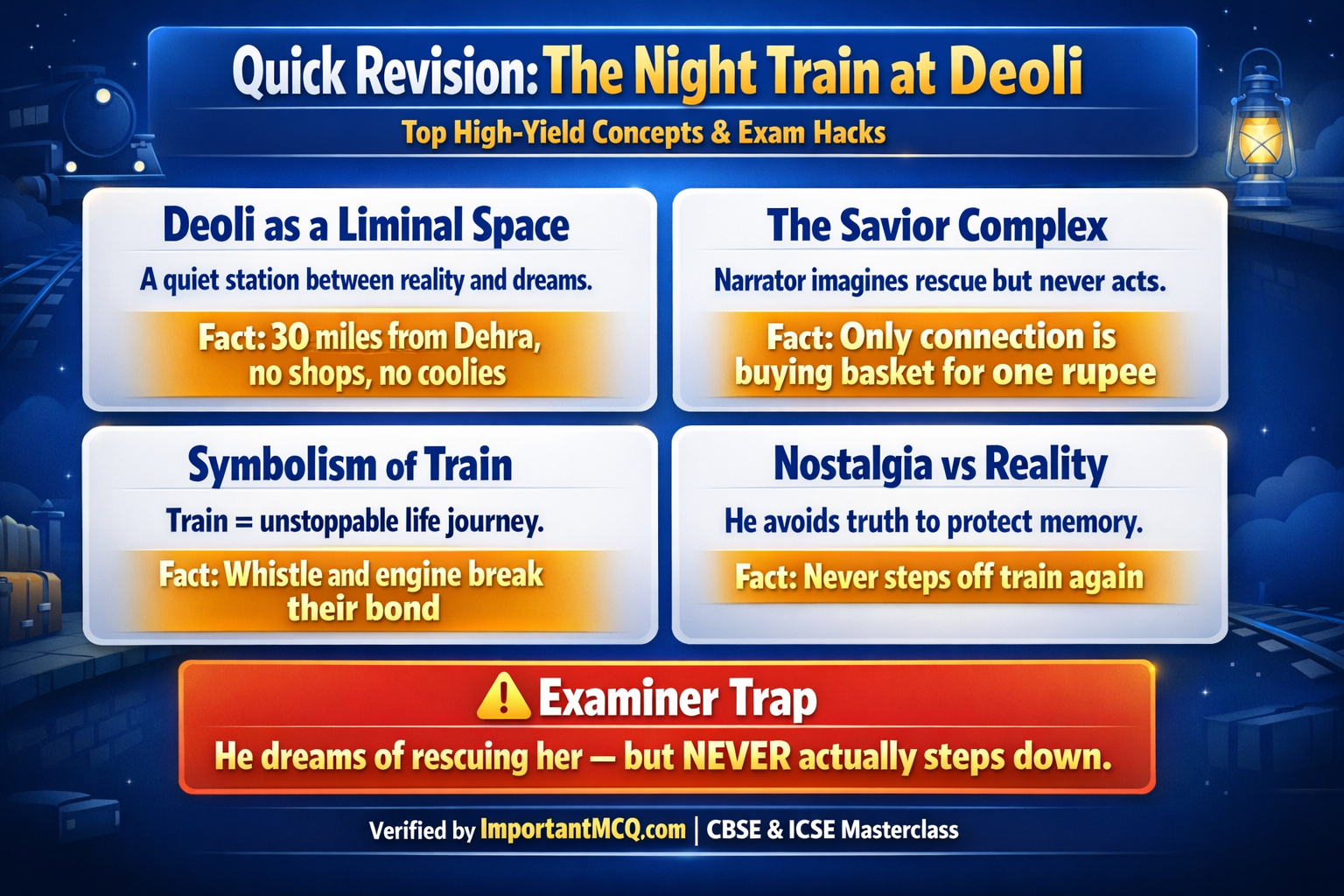
- 1, 2, and 3 High-Yield Core Concepts Deoli as a Liminal Space The isolated, desolate station acts as a transitional boundary between the narrator’s structured life in Delhi/Dehra and his romanticized fantasies, a common trope in classic Ruskin Bond short stories. The Illusion of the Savior Complex The character sketch of the narrator reveals a privileged college student who projects a heroic “rescue” fantasy onto an impoverished vendor, preferring the aesthetic of tragedy over the messy reality of helping her. The Symbolism of the Train The mechanical rhythm of the train represents relentless forward momentum and the unstoppable schedule of adulthood, literally forcing the narrator away from his youthful infatuation. Fear of Reality vs. Comfort of Nostalgia The ultimate tragedy of the story is the narrator’s deliberate choice to remain ignorant of the girl’s true fate (death or marriage) to protect his perfect, unchanging memory of their fleeting connection. Semantic Comparison: The Night Train at Deoli vs The Eyes Have It Feature / Metric The Night Train at Deoli The Eyes Have It Core Definition A story of an unresolved, fleeting romance at an isolated, forgotten railway station. A story of a brief, hidden connection between two blind passengers sharing a train compartment. Primary Use Case Explores themes of adolescent infatuation, nostalgia, and the fear of confronting harsh realities. Explores themes of perception, situational irony, and the desire to conceal one’s vulnerabilities. Exam Importance Highly tested on symbolism (liminal spaces, the train) and the socio-economic divide. Highly tested on dramatic irony, dialogue analysis, and sensory descriptive imagery.
Explanation
Direct Answer: Statements 1 and 2 are correct, while Statement 3 is incorrect.Concept Definition: Unresolved conflict leaves the future to the imagination.Structural Breakdown: Open ending preserves the “mystery.” Historical/Related Context: One of the most famous open endings in Indian English literature.Causal Reasoning: Statement 3 is incorrect because the open ending was a deliberate choice; no marriage sequel exists.🔗 Continue Practicing:➔ Active and Passive Voice MCQ – 100 Most Expected Questions