Looking for the most important bricks beads and bones mcq for your upcoming exams? We have analyzed past papers for CBSE Class 12 Boards, CUET UG, UPSC CSE, NDA, and State PSCs to bring you the 50 most expected questions. Take the live test, review the blueprint, and master the core concepts.
- 🚀 Updated for 2026: Aligned with the latest CBSE Class 12 Boards, CUET UG, UPSC CSE, NDA, and State PSCs syllabus.
- 🧠 Output & Concept Based: Covers basics to advanced scenarios.
- 📊 Live Gamification: Track your score and time dynamically.
- 📥 Buy PDF: Available instantly via our Telegram channel.
Test Blueprint & Topic Weightage
| Section / Topic | Question Range | Difficulty Level |
|---|---|---|
| Urban Planning & Civic Architecture | Q1 – Q5, Q16 – Q20 | Easy to Medium |
| Subsistence, Agriculture & Animal Hubandry | Q6 – Q10 | Medium |
| Craft Production & Maritime Trade Networks | Q11 – Q15, Q21 – Q30 | Hard |
| Society, Religion & Burial Practices | Q31 – Q40 | Medium to Hard |
| Archaeological Discovery & Civilization Decline | Q41 – Q50 | Medium to Hard |
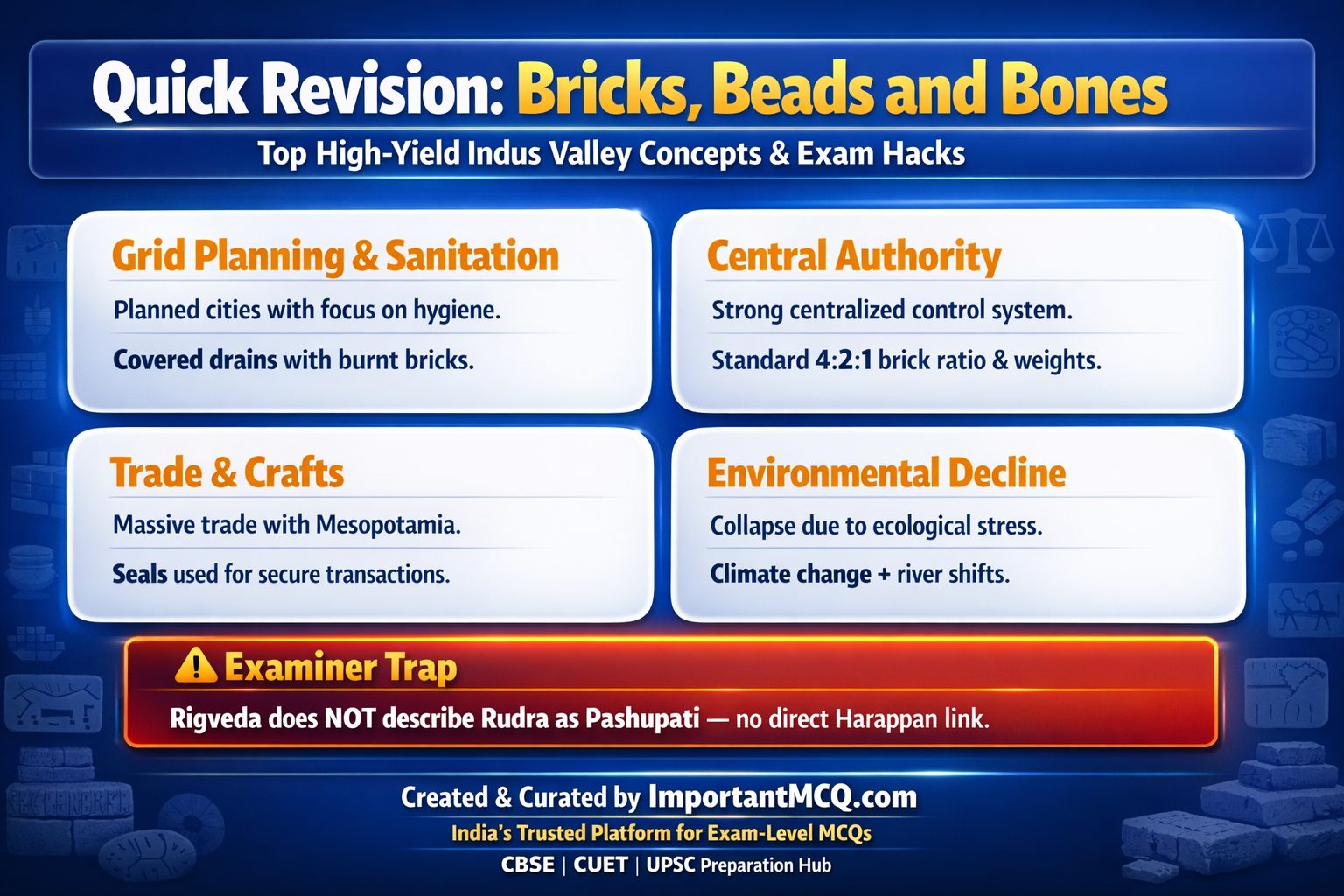
⚠️ Examiner Trap Alert: Examiners often trick students by claiming the ancient *Rigveda* explicitly describes the deity Rudra as a meditating yogi or “Pashupati” to perfectly match the Harappan Proto-Shiva seal. In reality, the Rigvedic text completely contradicts this visual imagery, a critical detail that debunks the direct connection between the seal and later Vedic texts.
Test Blueprint & Topic Weightage
⏱️ Estimated Time: Minutes | 🎯 Target Score: 40+ | 📊 Difficulty: Moderate to Hard
📚 Interactive Question Bank
Select a question to view the expert explanation and answer.
✅ General Practice
Q1Consider the following statements regarding the Town Layout and Brick Standardization in Mohenjodaro:Q2Consider the following statements regarding the Domestic Architecture and Privacy features of residential buildings in Mohenjodaro:Q3Consider the following statements regarding the Urban Drainage System and Street Alignment in Mohenjodaro:Q4Consider the following statements regarding the Great Bath of Mohenjodaro:Q5Consider the following statements regarding the specific variations in Harappan Citadels and urban amenities:
✅ | Subsistence, Agriculture & Animal Hubandry
Q6Consider the following statements regarding the dietary practices and archaeo-botanical evidence of the Harappan civilization:Q7Consider the following statements regarding animal domestication and wildlife interaction in the Harappan civilization:Q8Consider the following statements regarding the agricultural technologies and field ploughing practices of the Harappans:Q9Consider the following statements regarding the irrigation systems and water management for Harappan agriculture:Q10Consider the following statements regarding food processing implements and saddle querns in the Harappan civilization:
✅ General Practice
Q11Consider the following statements regarding the settlement of Chanhudaro and Harappan craft production:Q12Consider the following statements regarding the techniques of bead-making and material processing in the Harappan civilization:Q13Consider the following statements regarding the specialized procurement centers of Nageshwar and Balakot:Q14Consider the following statements regarding Harappan procurement expeditions and the Khetri region:Q15Consider the following statements regarding Harappan long-distance trade networks and interactions with Oman:Q16Consider the following statements regarding the structural materials and design of the Harappan street drains:Q17Consider the following statements regarding the engineering of massive sewers and the use of the corbelled arch in Harappan cities:Q18Consider the following statements regarding the civic water infrastructure and reservoirs at the settlement of Dholavira:Q19Consider the following statements regarding the civic infrastructure and building materials specifically found at Lothal:Q20Consider the following statements comparing Harappan civic amenities with those of contemporary ancient civilizations:Q21Consider the following statements regarding the Mesopotamian textual references to Harappan trade networks:Q22Consider the following statements regarding the archaeological evidence of trade between the Harappan civilization and Oman:Q23Consider the following statements regarding the role of Dilmun in the ancient maritime trade network:Q24Consider the following statements regarding the modes of transportation and logistics used in Harappan trade:Q25Consider the following statements regarding the presence and adaptation of Harappan artifacts in foreign lands:Q26Consider the following statements regarding the logistical purpose of Harappan seals and sealings:Q27Consider the following statements regarding the characteristics of the enigmatic Harappan script:Q28Consider the following statements regarding the standardized system of weights in the Harappan civilization:Q29Consider the following statements regarding the ubiquity of Harappan writing and the longest known inscriptions:Q30Consider the following statements regarding the enigmatic nature and the attempted decipherment of the Harappan script:
✅ | Society, Religion & Burial Practices
Q31Consider the following statements regarding the standard burial practices and pit variations found at Harappan sites:Q32Consider the following statements regarding the presence of grave goods and gender specific burials in the Harappan civilization:Q33Consider the following statements regarding the archaeological classification of utilitarian and luxury artifacts:Q34Consider the following statements regarding the spatial distribution of faience pots and Harappan gold:Q35Consider the following statements comparing Harappan burials with those of contemporary ancient civilizations:Q36Consider the following statements regarding the reconstruction of Harappan religious beliefs and the Mother Goddess:Q37Consider the following statements regarding the famous stone statue identified as the Priest-King:Q38Consider the following statements regarding the Proto-Shiva seal and its textual contradictions:Q39Consider the following statements regarding the archaeological evidence of animism and religious structures in the Harappan civilization:Q40Consider the following statements regarding the competing historical theories on Harappan political authority:
✅ | Archaeological Discovery & Civilization Decline
Q41Consider the following statements regarding the chronology and geographical shifting of the Late Harappan phase:Q42Consider the following statements regarding the environmental and climatic theories surrounding the Harappan decline:Q43Consider the following statements regarding the role of tectonic disturbances and floods in the decline of specific Harappan cities:Q44Consider the following statements regarding the Aryan Invasion Theory and its subsequent debunking by modern archaeology:Q45Consider the following statements regarding the collapse of Harappan central authority and the end of urbanization:Q46Consider the following statements regarding Alexander Cunningham and his early archaeological investigations in India:Q47Consider the following statements regarding the early 20th-century discoveries that led to the identification of the Harappan civilization:Q48Consider the following statements regarding John Marshall's tenure and his specific excavation methodology at Harappan sites:Q49Consider the following statements regarding R.E.M. Wheeler's contributions to Harappan archaeology:Q50Consider the following statements regarding the impact of the 1947 partition on Harappan archaeology and modern exploration:
Page 1 of 1 (50 Total Questions)
High-Yield Core Concepts
Urban Grid & Sanitation
Unlike contemporary civilizations, the Harappans uniquely prioritized egalitarian public sanitation, covered street drains, and strict grid-iron street planning over massive royal monuments.
Absolute Standardization
A highly centralized state authority is proven by the uncompromising uniformity of the 4:2:1 brick ratio and the strict binary/decimal chert weight system across the vast empire.
Logistics & Maritime Trade
Harappans sustained a complex international export economy with Oman (Magan) and Mesopotamia, securing their luxury goods with tamper-evident wet clay sealings.
Environmental Collapse
The end of the civilization was not caused by a sudden Aryan invasion, but rather by a complex matrix of long-term climatic aridity, shifting rivers, and massive anthropogenic deforestation.
Semantic Comparison
| Feature / Metric | Harappan Civilization | Mesopotamian Civilization |
|---|---|---|
| Core Definition | Highly standardized, egalitarian urban centers in the Indus Valley. | City-states centered around monumental royal and religious architecture. |
| Primary Use Case | Focus on public sanitation, uniform weights, and standardized grid streets. | Focus on massive Ziggurats, royal tombs, and complex cuneiform archives. |
| Exam Importance | Tests knowledge of town planning, trade seals, and environmental decline. | Tests comparative knowledge of ancient trade networks (Meluhha vs Magan). |
Frequently Asked Questions
Why are Indus Valley Civilization questions critical for my exams?
It is a consistently high-scoring area. Examiners frequently repeat core concepts from this section across multiple competitive platforms.
Is this the best Class 12 History Chapter 1 mock test available?
Yes, these questions target the most highly-weighted concepts, specifically tailored to align with modern Harappan town planning quiz formats found in previous years’ papers.
Will these help with CUET History objective questions?
Absolutely. The deep dive into archaeological methodology, seal interpretation, and trade routes perfectly mimics the high-level critical thinking required for CUET UG and UPSC Prelims.