Looking for the most important Strong Roots MCQs for your upcoming exams? We have analyzed past papers for WBCHSE Class 12 English Exam to bring you the 100 most expected questions. Take the live test, review the blueprint, and master the core concepts.
- 🚀 Updated for 2026: Aligned with the latest WBCHSE Class 12 English Exam syllabus.
- 🧠 Output & Concept Based: Covers basics to advanced scenarios.
- 📊 Live Gamification: Track your score and time dynamically.
- 📥 Buy PDF : Available instantly via our Telegram channel.
Test Blueprint & Topic Weightage
| Section / Topic | Question Range | Difficulty Level |
|---|---|---|
| Kalam’s Early Life & Maternal Lineage | Q1 – Q34 | Easy to Medium |
| Jainulabdeen’s Routine & Austerity | Q35 – Q65 | Medium |
| Communal Harmony & Inter-faith Dynamics | Q66 – Q80 | Medium to Hard |
| Psychological Insights & Metaphysics | Q81 – Q100 | Hard |
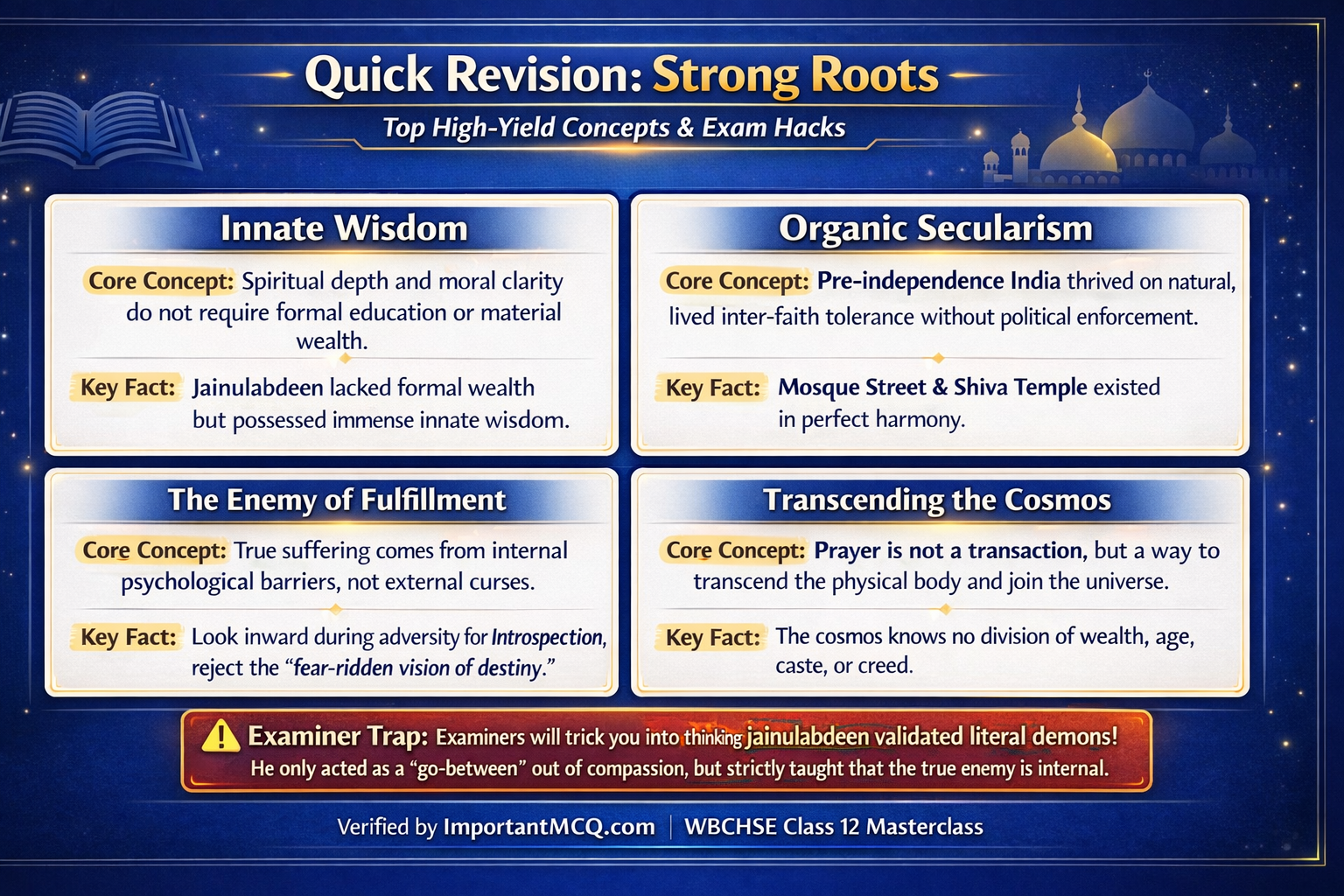
⚠️ Examiner Trap Alert: Examiners often trick students by suggesting Jainulabdeen validated literal “demons” or supernatural forces during his water-blessing rituals. Remember, he firmly believed in seeking the internal psychological “enemy of fulfillment” rather than blaming external, demonic forces for human distress.
Test Blueprint & Topic Weightage
⏱️ Estimated Time: 75 Minutes | 🎯 Target Score: 80+ | 📊 Difficulty: Moderate to Hard
📚 Interactive Question Bank
Select a question to view the expert explanation and answer.
✅ | Kalam's Early Life & Maternal Lineage
Q1Consider the following statements regarding the origin and core theme of Strong Roots:Q2Consider the following statements regarding Jainulabdeen and Ashiamma:Q3Consider the following statements regarding the lineage of Kalams mother:Q4Consider the following statements regarding Kalams childhood home:Q5Consider the following statements regarding Kalams physical appearance in comparison to his parents:Q6Consider the following statements regarding the lifestyle and provisions of Kalams father:Q7Consider the following statements regarding Kalams traditional dining habits during his childhood:Q8Consider the following statements regarding the socio-religious environment of Rameswaram as described by Kalam:Q9Consider the following statements regarding the Shiva temple of Rameswaram as described in Strong Roots:Q10Consider the following statements regarding the relationship between Jainulabdeen and Pakshi Lakshmana Sastry:Q11Consider the following statements regarding Kalams experience with the evening prayers:Q12Consider the following statements regarding the events that occurred outside the mosque after prayers:Q13Consider the following statements regarding Kalams inquiry into the nature of prayer:Q14Consider the following statements regarding Jainulabdeens philosophy on transcending the physical self:Q15Consider the following statements regarding Jainulabdeens views on adversity and suffering:Q16Consider the following statements regarding the role of a go-between as explained by Kalams father:Q17Consider the following statements regarding Jainulabdeens early morning routine:Q18Consider the following statements regarding the coconut grove mentioned in Strong Roots:Q19Consider the following statements regarding Jainulabdeens return from the coconut grove:Q20Consider the following statements regarding the persistence of Jainulabdeens daily routine:Q21Consider the following statements regarding Kalams emulation of his father:Q22Consider the following statements regarding Kalams belief in a divine power:Q23Consider the following statements regarding the role of divine power in overcoming adversity, as stated by Kalam:Q24Consider the following statements regarding the final philosophical message of Strong Roots:Q25Consider the following statements regarding the title "Strong Roots":Q26Consider the following statements regarding the concept of "inborn wisdom" as presented in the text:Q27Consider the following statements regarding Ashiammas role as an "ideal helpmeet":Q28Consider the following statements regarding the socio-economic status implied by the "pucca house":Q29Consider the following statements regarding the relationship between language and faith during the mosque prayers:Q30Consider the following statements regarding Jainulabdeens psychological interpretation of human distress:Q31Consider the following statements regarding the dual nature of Kalams secure childhood:Q32Consider the following statements regarding the dissolution of earthly divisions in Jainulabdeens philosophy:Q33Consider the following statements regarding Kalam's place in his family and his self-assessment:Q34Consider the following statements regarding the traditional meals served in Kalam's household:
✅ | Jainulabdeen's Routine & Austerity
Q35Consider the following statements regarding the sanctification ritual performed by Kalam's father:Q36Consider the following statements regarding the gratitude of the cured individuals:Q37Consider the following statements regarding Jainulabdeen's communication of spiritual concepts:Q38Consider the following statements regarding Jainulabdeen's concept of the "enemy of fulfillment":Q39Consider the following statements regarding the exact sequence of Jainulabdeen's morning routine:Q40Consider the following statements regarding Jainulabdeen's observations on human solitude and stalemates:Q41Consider the following statements regarding the geographical setting of Kalam's childhood:Q42Consider the following statements regarding the contrast between the family's assets and Jainulabdeen's lifestyle:Q43Consider the following statements regarding Kalam's intellectual transition regarding prayer:Q44Consider the following statements regarding the concept of the "manifest divine Being":Q45Consider the following statements regarding the specific states of distress mentioned by Kalam:Q46Consider the following statements regarding Jainulabdeen's physiological resilience:Q47Consider the following statements regarding the visual symbolism of Jainulabdeen and Pakshi Lakshmana Sastry:Q48Consider the following statements regarding the metaphor of the "road" in the text's conclusion:Q49Consider the following statements regarding Kalam's psychological reaction to his father's philosophical discourse:Q50Consider the following statements regarding the specific societal dividers mentioned in Jainulabdeen's philosophy of the cosmos:
Next 50 →
Page 1 of 2 (100 Total Questions)
High-Yield Core Concepts
Ancestral Roots & Security
Focusing on the APJ Abdul Kalam childhood, the text highlights his secure upbringing in a mid-19th century pucca house on Mosque Street, marked by his father’s strict austerity and mother’s generosity.
Communal Harmony
As seen in Wings of Fire chapter 1, the close friendship between Jainulabdeen and the Hindu high priest Pakshi Lakshmana Sastry exemplifies the organic secularism present in pre-independence Rameswaram.
Spiritual Transcendence
The cornerstone of Jainulabdeen philosophy is the belief that prayer allows an individual to transcend their physical body and become part of a cosmos completely devoid of earthly societal divisions.
Overcoming Adversity
This vital WBCHSE English prose teaches that suffering provides opportunities for introspection, urging individuals to identify their internal “enemy of fulfillment” rather than adopting a fear-ridden vision of destiny.
Semantic Comparison
| Feature / Metric | Strong Roots MCQs | The Eyes Have It MCQs |
|---|---|---|
| Core Definition | Autobiographical memoir by Dr. A.P.J. Abdul Kalam | Fictional short story by Ruskin Bond |
| Primary Use Case | Mastering themes of secularism, discipline, and family roots | Understanding situational irony, perception, and narrative voice |
| Exam Importance | High-weightage non-fiction prose section | High-weightage fiction/narrative section |
Frequently Asked Questions
Why is Strong Roots MCQs critical for WBCHSE Class 12 English Exam?
It is a consistently high-scoring area. Examiners frequently repeat core concepts from this section, especially regarding Jainulabdeen’s worldview and Kalam’s upbringing.
Does this mock test cover the full syllabus?
Yes, these questions target the most highly-weighted concepts found in previous years’ papers, spanning the entire chapter.
What are the most repeated topics?
Based on our blueprint, Kalam’s Early Life & Maternal Lineage and Jainulabdeen’s Routine & Austerity carry the highest weightage.