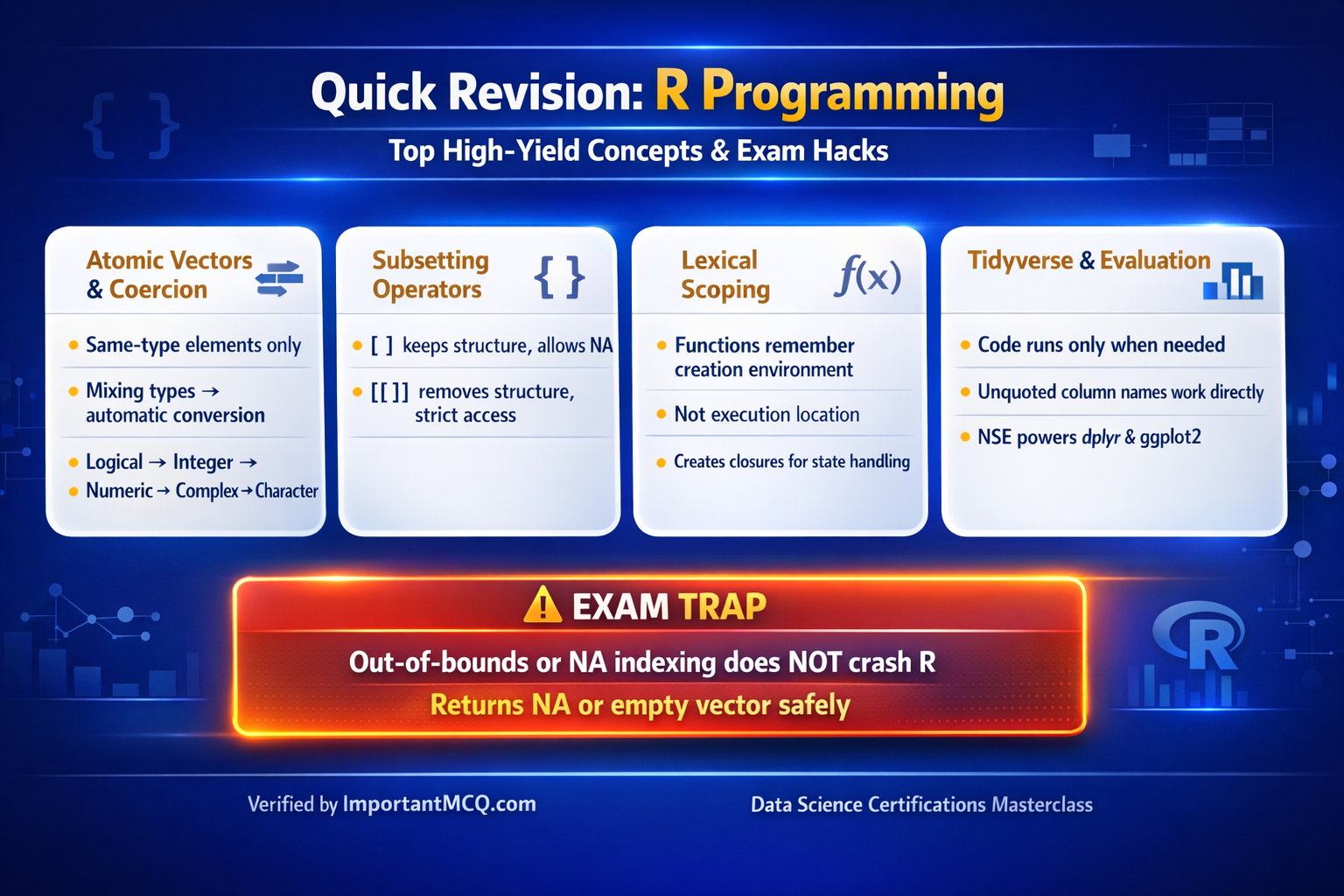
Looking for the most important R Programming MCQ for your upcoming exams? We have analyzed past papers for Data Science Certifications and University Statistics Exams to bring you the 84 most expected questions. Take the live test, review the blueprint, and master the core concepts.
- 🚀 Updated for 2026: Aligned with the latest Data Science Certifications and University Statistics Exams syllabus.
- 🧠 Output & Concept Based: Covers basics to advanced scenarios.
- 📊 Live Gamification: Track your score and time dynamically.
- 📥 Buy this PDF : Available instantly via our Telegram channel.
Test Blueprint & Topic Weightage
| Section / Topic | Question Range | Difficulty Level |
|---|---|---|
| Base R Data Structures & Subsetting | Q1 – Q16 | Easy to Medium |
| Environments & Functional Programming | Q17 – Q24 | Medium to Hard |
| Tidyverse Data Wrangling & Strings | Q25 – Q32, Q67 – Q72 | Medium |
| OOP Systems & Statistical Modeling | Q33 – Q39, Q57 – Q64 | Hard |
| Advanced Internals & Visualization | Q40 – Q56, Q73 – Q100 | Hard |
⚠️ Examiner Trap Alert: When testing subsetting, examiners frequently try to trick you into thinking an `NA` index or an out-of-bounds `[0]` index will crash your script. In reality, the single bracket `[` operator safely returns an `NA` or a zero-length vector without halting execution, whereas the double bracket `[[` is the strict operator that throws a fatal “out of bounds” error.
Test Blueprint & Topic Weightage
⏱️ Estimated Time: 75 Minutes | 🎯 Target Score: 67+ | 📊 Difficulty: Moderate to Hard
📚 Interactive Question Bank
Select a question to view the expert explanation and answer.
✅ | Base R Data Structures & Subsetting
Q1Consider the following statements regarding atomic vectors and coercion in R:Q2Consider the following statements regarding missing and null values in R:Q3Consider the following statements regarding the str() function and object attributes in R:Q4Consider the following statements regarding vectorization and recycling rules in R:Q5Consider the following statements regarding equality testing using all.equal() in R:Q6Consider the following statements regarding pattern matching functions in R:Q7Consider the following statements regarding raw vectors and hashing algorithms in R:Q8Consider the following statements regarding compression and file connections in R 4.4.0:
Page 1 of 1 (8 Total Questions)
High-Yield Core Concepts
Vector Recycling
When performing element-wise arithmetic on R data structures of unequal lengths, R automatically recycles elements of the shorter vector sequentially to match the longer vector.
Lazy Evaluation
Many base R functions implement lazy evaluation, meaning an argument’s expression is not mathematically evaluated until it is explicitly called or used inside the function body.
Formal & Informal Classes
R object-oriented programming utilizes multiple systems, where S3 relies on informal class attributes, while S4 requires strict blueprints and rigorous type-checking via slots.
Data Masking
Modern tidyverse syntax utilizes non-standard evaluation (NSE) algorithms to capture column names directly without requiring explicit string quoting, seamlessly binding datasets to visual or analytical properties.
Semantic Comparison
| Feature / Metric | R Programming | Python (for Data Science) |
|---|---|---|
| Core Definition | A language built specifically for statistical computing and graphics. | A general-purpose programming language with heavy data science libraries. |
| Primary Use Case | Academic research, advanced statistical modeling, and specialized data visualization (ggplot2). | Machine learning, deep learning, web scraping, and production deployment. |
| Exam Importance | Highly tested on statistical theory, data wrangling (tidyverse), and vectorization. | Highly tested on object-oriented design, algorithmic efficiency, and pandas/scikit-learn. |
Frequently Asked Questions
Why is R Programming MCQ critical for Data Science Certifications?
It is a consistently high-scoring area. Examiners frequently repeat core concepts from this section, especially regarding vectorization, subsetting rules, and functional programming logic.
Does this mock test cover the full syllabus?
Yes, these questions target the most highly-weighted concepts found in previous years’ papers, including recent updates to base R and the tidyverse ecosystem.
What are the most repeated topics?
Based on our blueprint, Base R Data Structures & Subsetting and Environments & Functional Programming carry the highest weightage for conceptual testing.