Looking for the most important Sexual Reproduction in Flowering Plants MCQ for your upcoming exams? We have analyzed past papers for NEET, CUET, and Class 12 Board Exams to bring you the 100 most expected questions. Take the live test, review the blueprint, and master the core concepts.
- 🚀 Updated for 2026: Aligned with the latest NEET, CUET, and Class 12 Board Exams syllabus.
- 🧠 Output & Concept Based: Covers basics to advanced scenarios.
- 📊 Live Gamification: Track your score and time dynamically.
- 📥 Buy PDF -100 MCQ: Available instantly via our Telegram channel.
Test Blueprint & Topic Weightage
| Section / Topic | Question Range | Difficulty Level |
|---|---|---|
| Pre-fertilization: Micro/Megasporogenesis | Q1 – Q35 | Easy to Medium |
| Pollination & Outbreeding Devices | Q36 – Q65 | Medium |
| Double Fertilization & Endosperm | Q66 – Q85 | Hard |
| Embryo, Seed, Fruit & Apomixis | Q86 – Q100 | Medium to Hard |
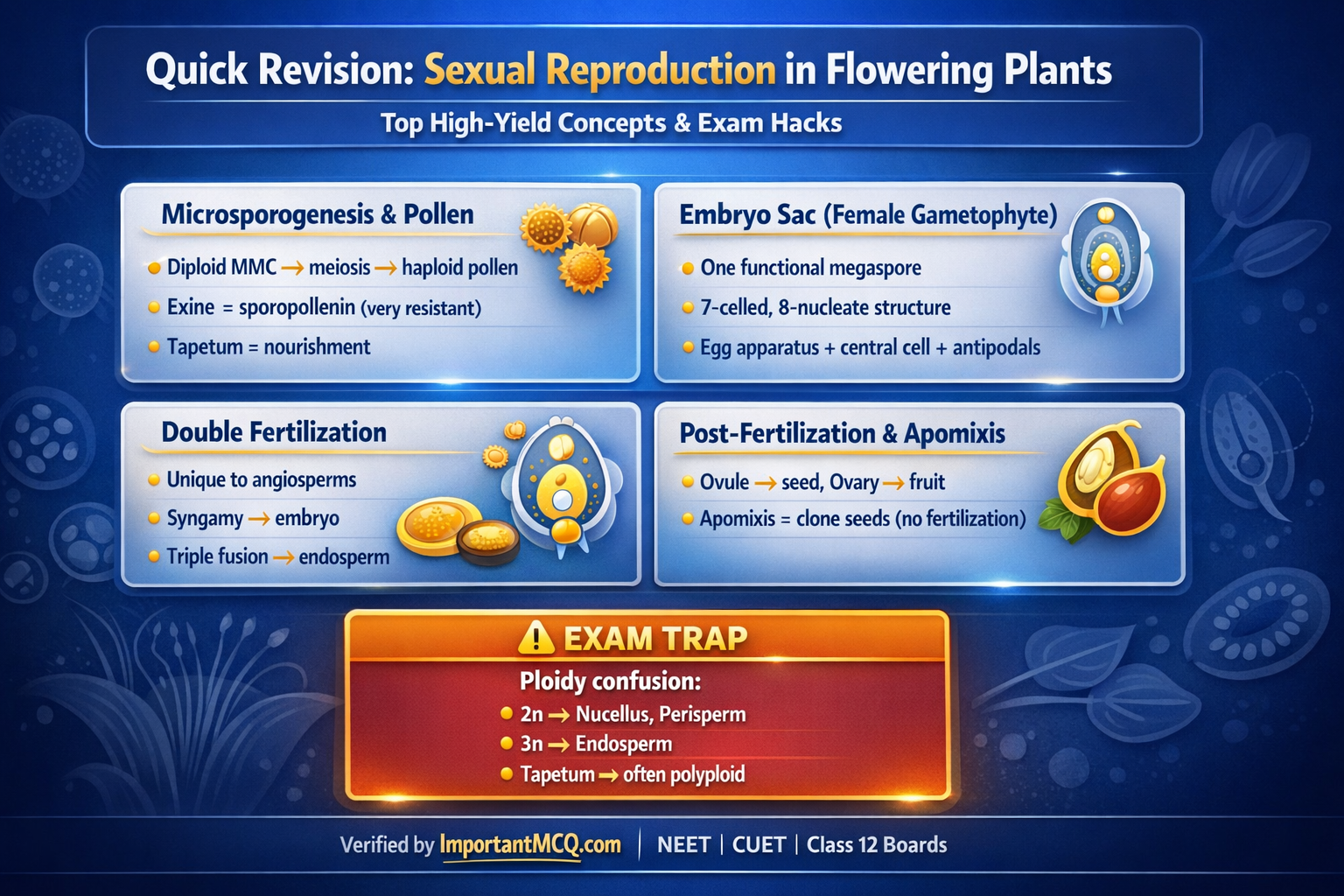
⚠️ Examiner Trap Alert: Examiners frequently trick students by conflating the ploidy levels of maternal tissues (like the diploid nucellus and perisperm) with post-fertilization structures. Always remember that the tapetum becomes polyploid to support microsporogenesis, while the endosperm is strictly a triploid (3n) tissue resulting from double fertilization.
Test Blueprint & Topic Weightage
⏱️ Estimated Time: 150 Minutes | 🎯 Target Score: 80+ | 📊 Difficulty: Moderate to Hard
📚 Interactive Question Bank
Select a question to view the expert explanation and answer.
✅ | Pre-fertilization: Micro/Megasporogenesis
Q1Consider the following statements regarding Microsporogenesis and the role of the Tapetum:Q2Consider the following statements regarding the anatomy of the pollen grain wall:Q3Consider the following statements regarding the shedding stages of pollen grains:Q4Consider the following statements regarding the structural components of the megasporangium (ovule):Q5Consider the following statements regarding megasporogenesis and embryonic development:Q6Consider the following statements regarding the nucleate stage and cell distribution of the embryo sac:Q7Consider the following statements regarding the filiform apparatus and associated structures:Q8Consider the following statements regarding the ploidy levels of various pre-fertilization structures:Q9Consider the following statements regarding the types of pollination in flowering plants:Q10Consider the following statements regarding cleistogamous and chasmogamous flowers:Q11Consider the following statements regarding anemophily (wind pollination) adaptations:Q12Consider the following statements regarding hydrophily (water pollination) mechanisms:Q13Consider the following statements regarding entomophily (insect pollination) and mutualistic interactions:Q14Consider the following statements regarding outbreeding devices in angiosperms:Q15Consider the following statements regarding pollen-pistil interaction:Q16Consider the following statements regarding the techniques of artificial hybridization:Q17Consider the following statements regarding the mechanics of syngamy and triple fusion:Q18Consider the following statements regarding the Primary Endosperm Cell (PEC) and its ploidy:Q19Consider the following statements regarding free-nuclear and cellular endosperm development:Q20Consider the following statements regarding albuminous and exalbuminous seeds:Q21Consider the following statements regarding the stages of dicot embryogeny:Q22Consider the following statements regarding the anatomy of a dicotyledonous embryo:Q23Consider the following statements regarding the anatomy of a monocotyledonous embryo:Q24Consider the following statements regarding the formation and function of the suspensor:Q25Consider the following statements regarding the classification of true and false fruits:Q26Consider the following statements regarding parthenocarpy and hormonal induction:Q27Consider the following statements regarding the perisperm in mature seeds:Q28Consider the following statements regarding seed dormancy and maturation dehydration:Q29Consider the following statements regarding historical records of seed viability:Q30Consider the following statements regarding the mechanisms of apomixis:Q31Consider the following statements regarding the occurrence of polyembryony:Q32Consider the following statements regarding the evolutionary advantages of seeds in angiosperms:Q33Consider the following statements regarding the release and geometry of microspore tetrads:Q34Consider the following statements regarding pollen allergy and artificial preservation:Q35Consider the following statements regarding the spatial orientation of ovules:
✅ | Pollination & Outbreeding Devices
Q36Consider the following statements regarding the pathways of pollen tube entry:Q37Consider the following statements regarding the physiological requirements for pollen germination:Q38Consider the following statements regarding the helobial type of endosperm development:Q39Consider the following statements regarding the mechanics of cleavage polyembryony:Q40Consider the following statements regarding the hormonal regulation of seed dormancy:Q41Consider the following statements regarding the duration of pollen viability:Q42Consider the following statements regarding the structure and function of the endothecium:Q43Consider the following statements regarding the structural types of the tapetum:Q44Consider the following statements regarding the post-fertilization degradation of embryo sac components:Q45Consider the following statements regarding the comparative origin and ploidy of the endosperm:Q46Consider the following statements regarding megasporogenesis and the megaspore tetrad:Q47Consider the following statements regarding temporal and physical outbreeding devices:Q48Consider the following statements regarding floral rewards and nectar guides in insect pollination:Q49Consider the following statements regarding the epiblast in monocotyledonous embryos:Q50Consider the following statements regarding structural arrangements that prevent inbreeding:
Next 50 →
Page 1 of 2 (100 Total Questions)
High-Yield Core Concepts
Microsporogenesis & Tapetum
The diploid microspore mother cell undergoes meiosis to form haploid pollen grains, while the polyploid tapetum provides essential nourishment and sporopollenin precursors. Practicing Class 12 Botany MCQs will help solidify this tissue hierarchy.
Embryo Sac Architecture
The mature female gametophyte is strictly 7-celled and 8-nucleate, structurally oriented with the egg apparatus at the micropylar end and antipodals at the chalazal end.
Double Fertilization
A hallmark of angiosperms involving syngamy (forming the diploid zygote) and triple fusion (forming the triploid primary endosperm nucleus). Mastering double fertilization questions is non-negotiable for medical entrance exams.
Post-Fertilization Modifications
The ovary ripens into a fruit and the ovules harden into seeds, a transformation you can review in detail by downloading our angiosperm reproduction PDF.
Semantic Comparison
| Feature / Metric | Sexual Reproduction in Flowering Plants MCQ | Asexual Plant Reproduction (Apomixis/Vegetative) |
|---|---|---|
| Core Definition | Fusion of male and female gametes via pollination and fertilization. | Formation of new plants without gametic fusion or meiosis. |
| Primary Use Case | Generates genetic variation to drive evolutionary adaptation. | Preserves exact maternal genotypes and hybrid vigor indefinitely. |
| Exam Importance | Extremely high weightage; covers anatomy, embryology, and genetics. | Moderate weightage; heavily tested on exceptions like adventive embryony. |
Frequently Asked Questions
Why is Sexual Reproduction in Flowering Plants MCQ critical for NEET, CUET, and Class 12 Board Exams?
It is a consistently high-scoring area. Examiners frequently repeat core concepts from this section, particularly focusing on ploidy levels and structural anatomy.
Does this NEET Biology mock test cover the full syllabus?
Yes, these questions target the most highly-weighted concepts found in previous years’ papers, spanning from microsporogenesis to seed dormancy.
What are the most repeated topics?
Based on our blueprint, Pre-fertilization: Micro/Megasporogenesis and Double Fertilization carry the highest weightage.